Transformer Sizing & Load Assessment: Engineering and Procurement Guide
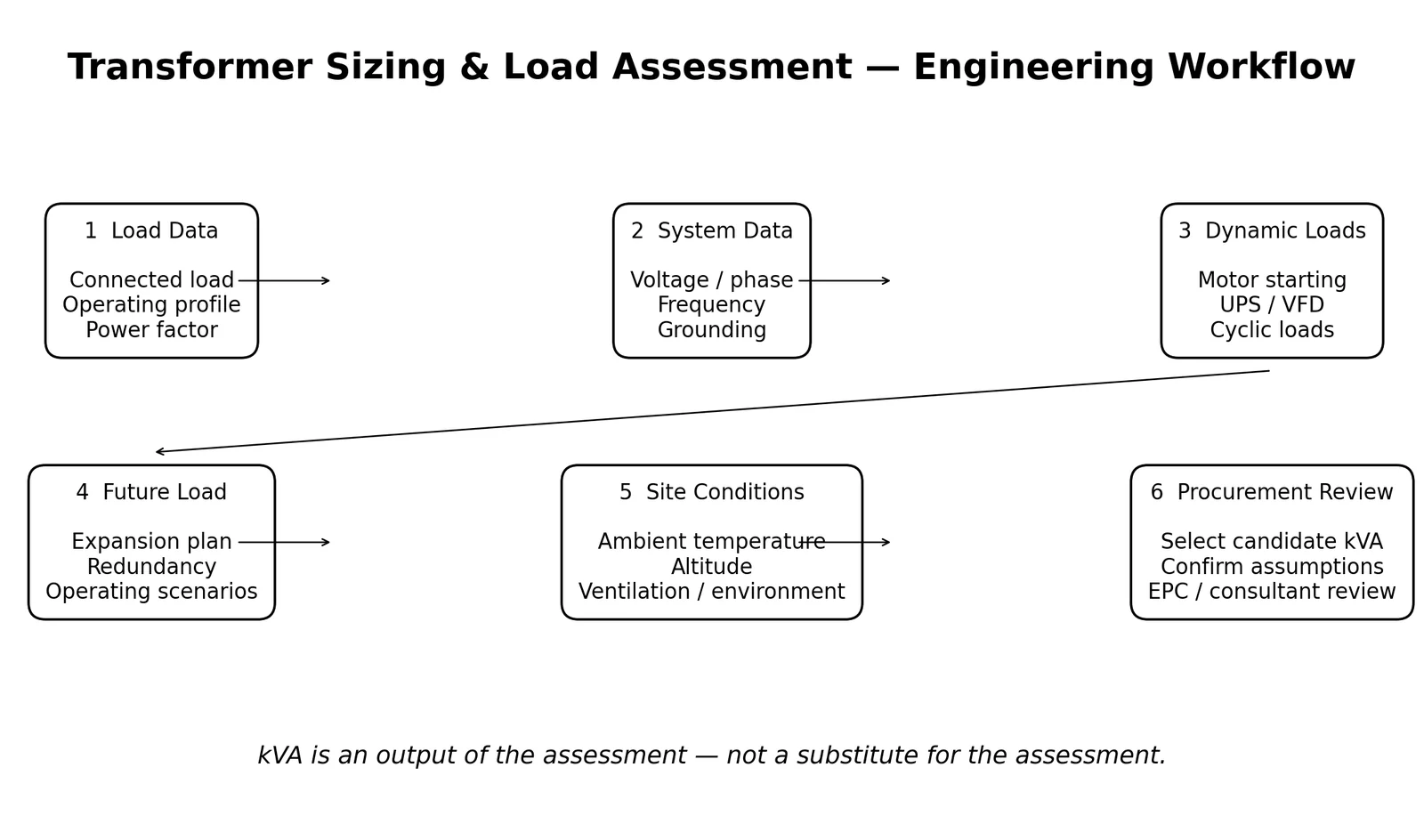
Transformer sizing should be built from load, system, dynamic-duty, future-load and site-condition inputs before a candidate kVA is selected.
Why a requested kVA is not yet a complete RFQ
- A buyer may already have a number such as 75, 100, 500 or 2,500 kVA. It may come from an old nameplate, a preliminary equipment list, a previous project, a supplier suggestion or an early budget estimate.
- The number alone does not describe how the load operates. Two projects that both say “500 kVA” can have very different power factors, motor-starting requirements, load profiles, harmonic content, redundancy plans, ambient conditions or altitude. Those differences can change the transformer specification and the surrounding electrical design.
- For that reason, TransformerGrid treats the first kVA figure as a starting assumption to be checked: Where did it come from? Which inputs are measured? Which are estimated? Which still require project engineering confirmation?
A six-layer sizing workflow
1. Connected load: identify what is installed. Installed equipment is not automatically the same as simultaneous demand.
2. Operating demand: identify which loads run together, for how long, and under which normal or peak scenarios.
3. Power factor and apparent power: for conventional AC loads, kVA ≈ kW/PF is a useful first-pass relationship; nonlinear loads may require additional harmonic and thermal review.
4. Dynamic duty: large motors, cyclic loads and other short-duration events can matter even when steady-state kVA looks acceptable.
5. Future load and redundancy: expansion should be written as an explicit future load case rather than hidden inside an arbitrary margin.
6. Site and system conditions: voltage, phase, frequency, grounding, ambient temperature, altitude, ventilation and environment belong in the sizing review.
Do not combine every uncertainty into one margin
- A percentage margin can be useful during very early budgeting, but it should not replace the final engineering review. Future expansion, motor starting, harmonics, high ambient temperature, high altitude and redundancy are different problems with different inputs.
- When they are all hidden inside one “extra 25%,” the supplier cannot tell whether the design needs more kVA, different impedance, different cooling, a different connection, a different starting method or simply better operating data.
Buyer should specify
- Primary voltage, secondary voltage, frequency and single-phase or three-phase service.
- A load list showing equipment, quantity, kW or kVA and power factor or nameplate data.
- Which loads are continuous, intermittent or simultaneous, and whether meaningful peaks exist.
- Largest motors, pumps, compressors or chillers and their starting methods.
- UPS, VFD, rectifier, server-power or other nonlinear loads and available manufacturer data.
- Current load and planned future load as separate cases.
- Site location, altitude, design ambient conditions, indoor/outdoor arrangement, ventilation and environmental exposure.
- For replacement projects: old transformer nameplate, single-line diagram, measured A/B/C phase currents and historical loading when available.
Supplier should submit
- A proposed transformer rating and the assumptions used to support that proposal.
- Rated voltages, frequency, connection/vector group, impedance and cooling basis.
- Rated currents, losses and thermal/cooling data relevant to the offered design.
- A clarification list for missing load or system data rather than undocumented assumptions.
- Drawings, nameplate data and interface details required for review.
- A clear list of system-level items that remain for EPC/consultant/owner approval.
What FAT can and cannot prove
- Factory acceptance testing can verify transformer evidence such as ratio, winding connection, impedance, losses and other specified tests. Those data are important inputs to the project design.
- FAT does not reproduce the customer’s utility short-circuit strength, feeder impedance, real motor-starting sequence, installed grounding arrangement or future load profile. It therefore cannot by itself prove that the transformer is compatible with the entire site.
- The evidence chain is stronger when procurement inputs, drawings, FAT data and site verification all refer to the same design assumptions.
Common procurement errors
- Copying the old transformer kVA into a replacement RFQ without checking the current load.
- Adding equipment nameplate kW and treating the result as kVA.
- Using one fixed safety factor to cover every unknown condition.
- Comparing supplier prices when each supplier is using different load assumptions.
- Assuming a larger transformer automatically solves harmonics, starting, grounding, protection or interface problems.
FAQ
Can TransformerGrid decide the final transformer rating for my project?
TransformerGrid can organize the load data, identify specification gaps and coordinate technical information with verified manufacturing partners. Final system design and rating approval should remain with the responsible EPC, consultant, utility or owner engineer under the applicable project requirements.
Can we start with only an old nameplate and site photos?
Yes. Replacement work can begin with the old nameplate, primary/secondary voltage, single-line diagram, measured phase currents, site conditions and expansion plans, then close the remaining data gaps.
Is a larger kVA always safer?
No. A larger rating can provide capacity headroom, but it does not automatically correct voltage, connection, harmonics, starting, grounding, protection or mechanical-interface errors.