Transformer Sizing & Load Reality · W6
Transformer Sizing for Ambient Temperature, Altitude and Site Conditions
Direct answer: The same nameplate kVA does not necessarily provide the same thermal and insulation margin at every site. High ambient temperature reduces heat-transfer margin; high altitude can affect air cooling and external insulation; indoor ventilation, solar exposure, dust, salt, humidity and enclosure conditions can change the design basis. Derating, temperature-rise limits and insulation corrections should therefore be confirmed for the specific transformer type, cooling system, applicable standard and project service conditions. A universal ambient/altitude derating table should not replace manufacturer and project engineering.
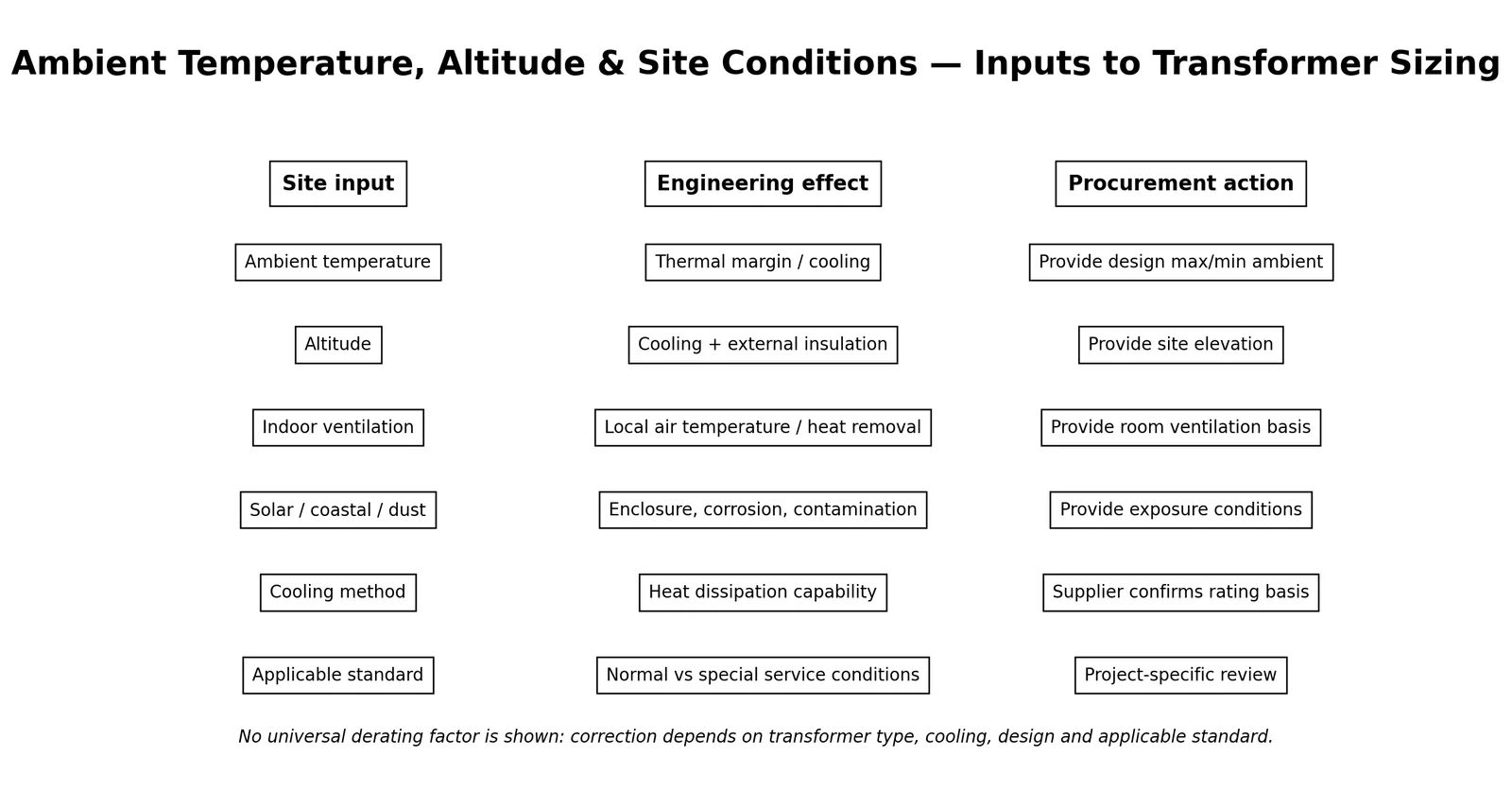
Site conditions are separate engineering inputs. Derating or design corrections must come from the applicable transformer design and standard, not from one universal table.
Project location is more than a freight address
- A country or city name is not enough to define transformer service conditions. The same country can include coastal, high-altitude, desert, tropical, dusty and conditioned-indoor installations.
- The RFQ should provide measurable environmental inputs so the manufacturer can determine whether cooling, external insulation, enclosure, coating or accessories require a different design basis.
Ambient temperature and thermal margin
- Transformer losses must ultimately be rejected to the surrounding environment. As ambient temperature rises, the temperature difference available for heat rejection decreases and critical internal temperatures can move closer to their design limits.
- The applicable thermal model depends on whether the transformer is liquid-immersed or dry type, the cooling method, insulation system and the governing IEC/IEEE/project requirements. A generic “X% derating per degree” should not be published as a universal rule.
Altitude can affect both cooling and dielectric design
- Air density decreases with elevation. For air-cooled external surfaces, forced-air systems and dry-type transformers, heat-transfer conditions can change.
- Altitude can also affect external air-insulation strength. Thermal and dielectric reviews should therefore be treated as related but separate tasks rather than collapsed into one universal altitude factor.
Indoor installation: ventilation is part of the service condition
- An indoor transformer can experience a local ambient temperature much higher than the outdoor weather data if heat removal is poor.
- The design review should consider room inlet/outlet airflow, ventilation fans or louvers, adjacent heat sources, recirculation, maintenance clearance and the indoor design temperature.
Outdoor environment can require additional design inputs
- Solar exposure and shading.
- Coastal salt or corrosive atmosphere.
- Industrial dust, mine dust or sand.
- High humidity, condensation and rainfall.
- Low temperature, icing or large daily temperature swings.
- Seismic, wind or other structural requirements when specified.
- Enclosure and animal/insect protection where applicable.
Keep thermal, dielectric and environmental corrections separate
- High ambient temperature is primarily a thermal-service issue. High altitude can be both thermal and dielectric. Pollution can affect creepage, bushings and external insulation. Corrosion can affect materials and coating systems.
- One generic “site derating factor” cannot reliably replace these separate engineering checks.
Buyer should specify
- Site location and elevation.
- Design maximum/minimum ambient conditions and their basis.
- Indoor/outdoor installation and ventilation basis.
- Solar exposure, pollution, dust, coastal/corrosive or high-humidity conditions.
- Available space and nearby heat sources.
- Applicable utility/project standards and special environmental or seismic requirements.
Supplier should submit
- The service conditions under which the offered kVA rating applies.
- Design response or limitations for conditions outside the normal-service basis.
- Cooling method and relevant thermal data.
- Altitude-related external-insulation/clearance confirmation where applicable.
- Environmental suitability of coating, enclosure, materials and accessories when specified.
FAQ
Does every high-altitude project require the same derating?
No. The response depends on transformer type, elevation, cooling, insulation design and the applicable standard.
Why can the same 500 kVA transformer run hotter at one site?
Ambient temperature, ventilation, elevation, solar exposure, loading and cooling conditions all influence thermal margin.
Is the country name enough to specify the environment?
No. Provide the actual site elevation, design ambient conditions and installation/environmental exposure.
Related Story from the Blog:
Buying or sourcing a transformer? Contact: sales@transformergrid.com