Transformer Sizing & Load Reality · W2
Transformer Load Calculation: kW, kVA, Power Factor, Connected Load, Demand and Diversity
Direct answer: The purpose of transformer load calculation is to build an auditable demand model, not to add all equipment nameplates and immediately select a transformer. For conventional AC loads, kVA ≈ kW/PF is a useful first-pass relationship. Single-phase current can be estimated from I = S/V and balanced three-phase line current from I = S/(√3·VLL), using consistent units. Final sizing must still address realistic simultaneous demand, motor starting, nonlinear loads, future expansion and site conditions. No single demand factor or diversity factor is appropriate for every project.
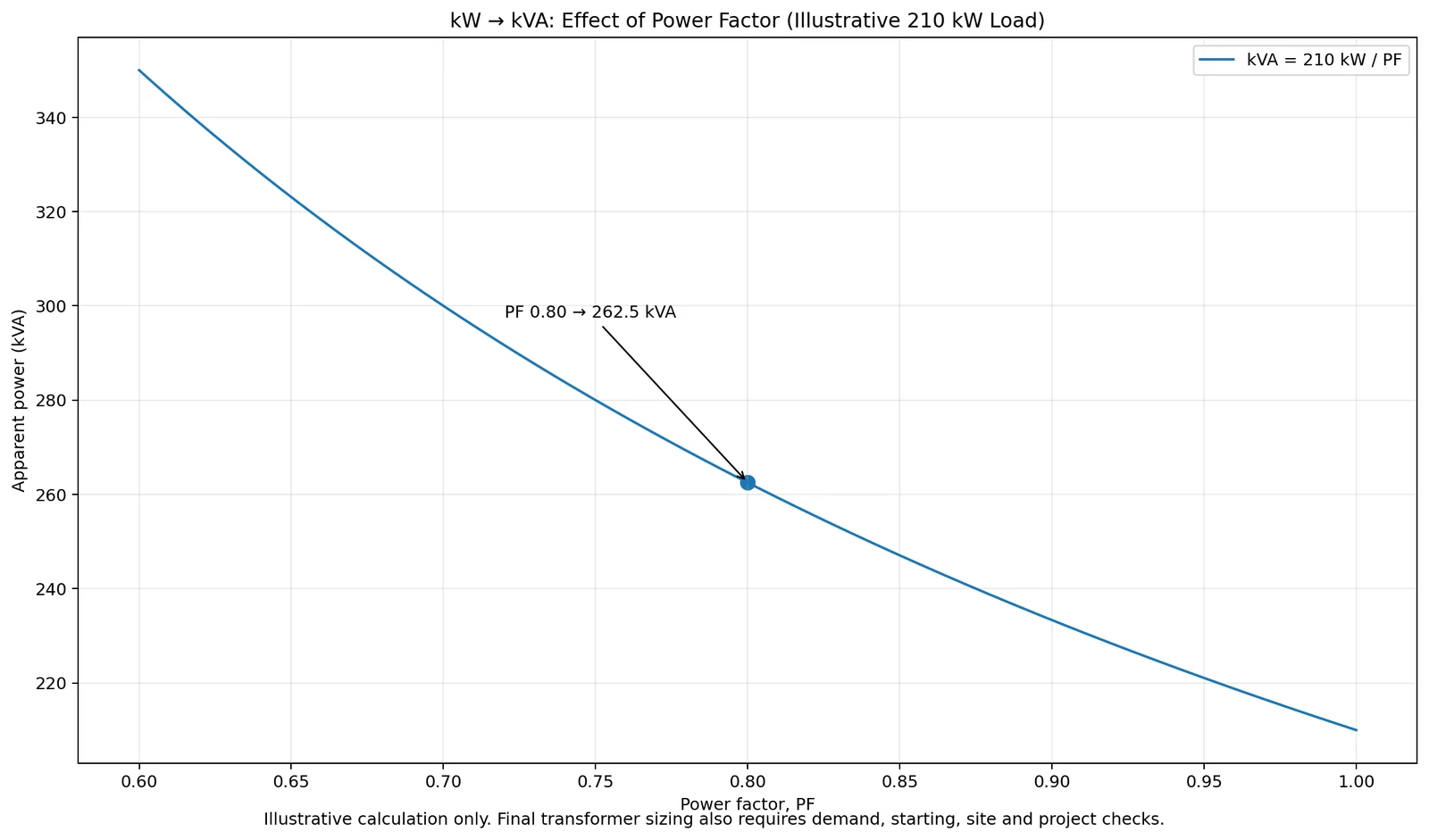
For an illustrative 210 kW load, lower power factor increases apparent power. This is a first-pass relationship, not a complete transformer sizing decision.
kW and kVA are not interchangeable
- kW describes active power; kVA describes apparent power. For conventional AC loads with a known power factor and suitable waveform assumptions, kVA ≈ kW/PF.
- Example: an illustrative 210 kW operating load at PF = 0.80 corresponds to 262.5 kVA of apparent power. That number is a calculation checkpoint, not an automatic instruction to purchase a particular standard transformer size.
- If power factor, harmonic content or the actual operating combination changes, the apparent-power requirement can change as well.
Single-phase and three-phase current relationships
- Single phase: S(kVA) = V × I / 1000, therefore I ≈ 1000S/V.
- Balanced three phase: S(kVA) = √3 × VLL × IL / 1000, therefore IL ≈ 1000S/(√3 × VLL).
- Capacity, voltage and phase system must be stated together. “75 kVA” alone does not define rated current or the required downstream interface.
Connected load is not the same as operating demand
- Connected load is the sum of installed equipment ratings. Operating demand asks what the system is reasonably expected to carry in a defined operating scenario.
- Ten 30 kW machines create 300 kW of connected load, but they may not operate simultaneously at full output. The opposite mistake is also possible: assuming that loads “usually” do not coincide even though process changes or future expansion can make them overlap.
- A useful load schedule records installed rating, duty cycle, simultaneous operating groups, peak duration, largest individual load, seasonal behavior and planned expansion.
Demand and diversity factors must be defined before use
- Demand factor, diversity factor and coincidence factor are not interchangeable labels. Definitions and accepted methods can vary by local code, utility practice and project methodology.
- A generic value copied from another project should not become a universal input. The procurement record should identify what the factor means, which loads it applies to and what operating scenario it represents.
A procurement-ready load table should include
- Equipment or circuit name and quantity.
- Unit and total kW/kVA.
- Power factor and whether it is measured, nameplate or assumed.
- Continuous, intermittent, standby or seasonal duty.
- Simultaneous operating group.
- Motor-starting method where relevant.
- Nonlinear-load identification such as UPS, VFD or rectifier.
- Future expansion as a separate load case.
Why one fixed margin is weak engineering
- If every uncertainty is hidden inside “+20%,” downstream reviewers cannot see what the extra capacity is intended to cover.
- Future expansion, starting duty, thermal environment and data uncertainty should be recorded separately so that the final design can address the real cause rather than only increase kVA.
Illustrative screening example
- Assume a defensible operating demand of 210 kW and an initial PF estimate of 0.80. The first-pass apparent power is approximately 262.5 kVA.
- The next questions are more important than immediately rounding to a transformer size: Is 210 kW a demand case or only connected load? What is the largest motor? Are UPS/VFD loads present? Is future expansion planned? Are the phase loads reasonably distributed? Are the site conditions normal for the offered design?
FAQ
Should I add all equipment nameplates to size the transformer?
That produces connected load, not necessarily the operating demand used for final sizing.
Does 210 kW at PF 0.80 mean I should buy a 300 kVA transformer?
262.5 kVA is the first-pass apparent-power result. The final rating depends on dynamic duty, expansion, load profile, environment and the responsible project design.
Is there a universal demand factor?
No. Use the project methodology, local requirements, measured data or a documented engineering assumption.
Related Story from the Blog:
Buying or sourcing a transformer? Contact: sales@transformergrid.com