“Just Buy the Next Size Up.” Why Oversizing Isn’t Automatically Safer
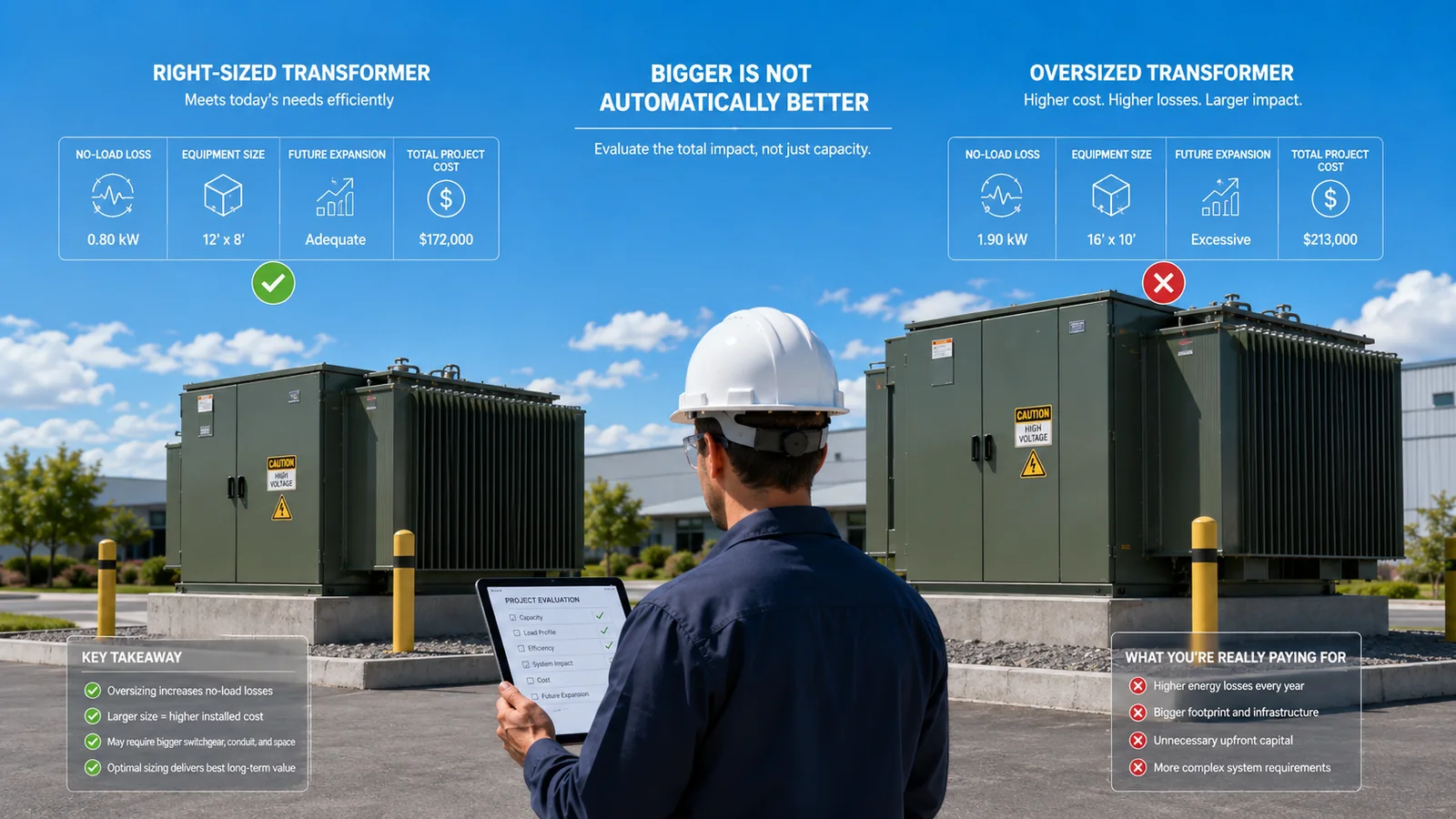
The instinct sounds safe
The load review points to roughly 500 kVA. The buyer says, “Then let’s buy 750 kVA. Bigger cannot hurt.”
It is an understandable procurement instinct. But electrical-system safety is not determined by the size printed on one nameplate.
What extra capacity can and cannot solve
A higher rating may provide future load room and reduce loading percentage in some operating conditions. It does not automatically correct the wrong voltage, an incompatible winding connection, bad protection coordination, poor motor-starting strategy, harmonics, grounding issues, or site-interface problems.
Bigger also has system consequences
- transformer acquisition cost
- no-load losses and operating economics
- upstream/downstream equipment ratings
- breakers and protection
- cables and bus
- physical size and foundation
- transport and installation
Future expansion should be specified, not guessed
If a second production line is planned in two years, put the expected future load into the load schedule. If expansion is uncertain, describe the range and phase. Then the buyer, EPC, and manufacturing partner can discuss whether to reserve capacity now or use staged, parallel, or other system solutions.
TransformerGrid is not against margin
We are against unexplained margin. “Why are we reserving this capacity, for what load, and when?” is a much better question than “what is the next larger standard size?”
A stronger RFQ separates current load, future load, operating mode, and expansion plan.
Before choosing 500 or 750 kVA, send the reason
If you are deciding between 300 and 500 kVA, or 500 and 750 kVA, send the present load and the expansion plan. TransformerGrid can help separate today’s requirement from tomorrow’s option before quotation.
Margin should have a reason. Bigger can be a solution; it should not be the default answer.
Send your project data before you lock the kVA
If you are buying or replacing a transformer, send the load list, single-line diagram, equipment nameplates and the site information you already have. TransformerGrid can help organize the RFQ inputs and coordinate manufacturing-side technical information before quotation moves too far.
Selected for State Grid projects. Proven across extreme climates.
Manufacturing experience backed by documented project awards through a verified manufacturing partner.
Buying or sourcing a transformer? Contact:
WhatsApp: +86 176 8746 9988