Transformer Sizing & Load Reality · W3
Single-Phase vs Three-Phase Transformers: Current, Load Compatibility and Procurement Selection
Direct answer: The choice between single-phase and three-phase transformers should follow the upstream supply, downstream load mix, voltage requirements, grounding arrangement and utility/project requirements. The same kVA does not imply the same current when voltage or phase system changes. A conventional transformer can change voltage, provide isolation and implement a specified winding connection, but it does not create a missing three-phase source from a single-phase supply. If the real problem is phase conversion, that system question must be solved before transformer selection.
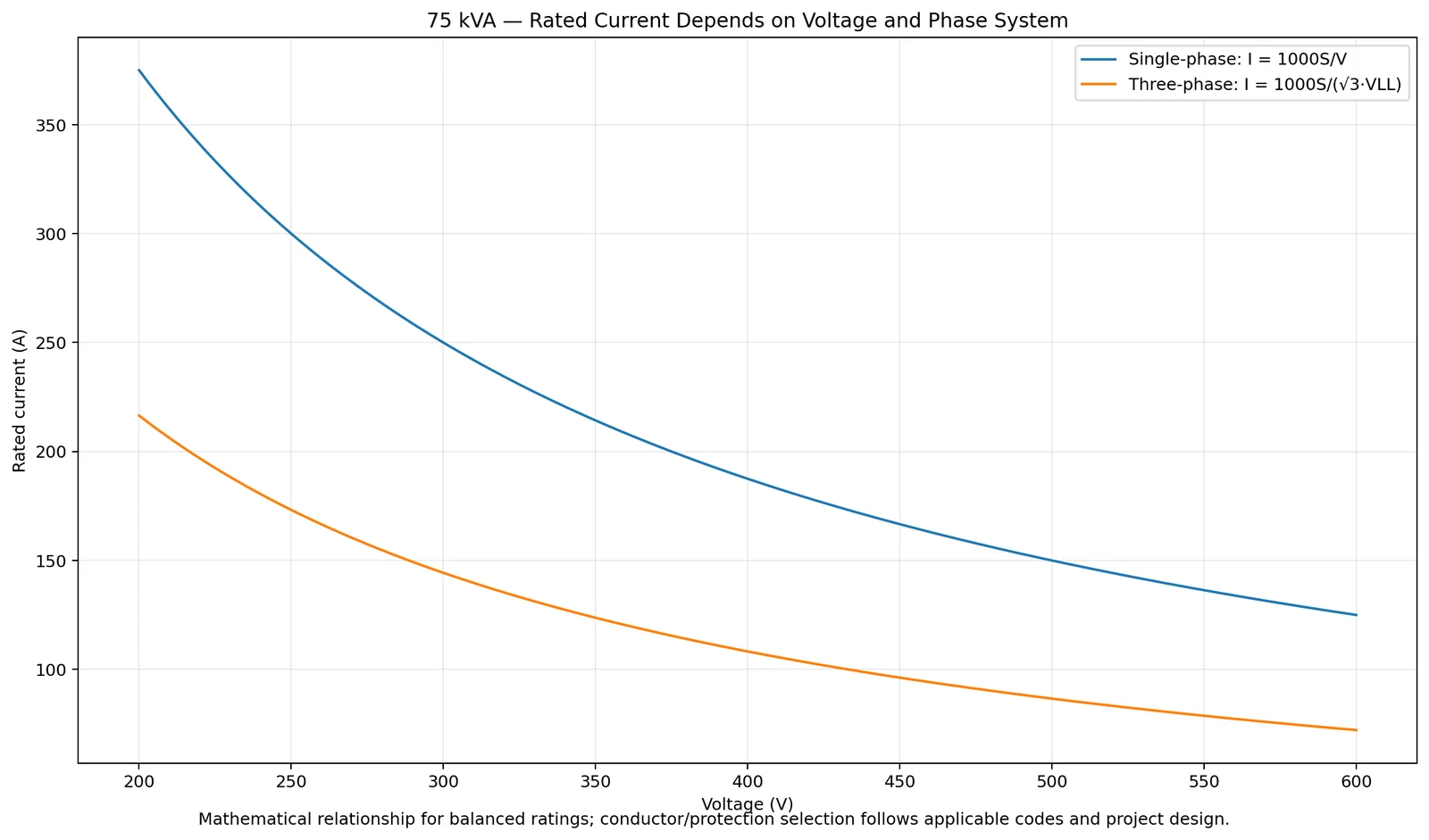
For the same kVA, rated current depends on voltage and the phase system. kVA alone does not define the electrical interface.
Start with the electrical system, not the product label
- Confirm whether the utility or upstream source is single phase or three phase, which downstream loads require three phase, whether single-phase branch loads need a neutral, and which line-to-line or line-to-neutral voltages are required.
- Without those inputs, a price comparison between a single-phase and three-phase transformer may be comparing two different system solutions.
The same kVA can mean very different rated current
- Single phase: I ≈ 1000S/V. Balanced three phase: I ≈ 1000S/(√3 × VLL).
- The accompanying figure plots these exact rating relationships for an illustrative 75 kVA case. It is intended to show why kVA cannot be interpreted without voltage and phase information.
- Conductor and protection selection must still follow the applicable electrical code and project design; the current equations do not replace that review.
Downstream loads make the phase choice meaningful
- Residential, rural and light-commercial services may be dominated by single-phase loads.
- Large motors, pumps, compressors, elevators, large HVAC systems and industrial process equipment commonly require three-phase supply.
- When many single-phase loads are supplied from a three-phase four-wire system, phase allocation and neutral current become part of the design.
A normal transformer is not a phase converter
- A transformer transfers power magnetically between windings and can change voltage, isolation and connection characteristics. It does not generate the missing phase sequence needed for a true three-phase source when the upstream supply is only single phase.
- If the project question is “single-phase source to three-phase motor,” the responsible engineer may need to evaluate a utility service upgrade, VFD, static/rotary phase conversion or another appropriate architecture before the transformer location and rating are finalized.
Connections, neutral and grounding
- Delta/wye, wye/wye and other three-phase connections affect neutral availability, phase displacement, zero-sequence behavior and protection. No single vector group is universally best.
- The buyer should specify or confirm the required connection from the utility/EPC single-line and grounding design. The supplier should submit the vector group, terminal identification, phase relationship and grounding interface for approval.
Procurement checklist
- Upstream single-phase or three-phase service and available voltage.
- Downstream load phase requirements and major three-phase equipment.
- Required line-to-line and line-to-neutral voltages.
- Neutral and grounding requirements.
- Whether the underlying problem is voltage conversion or phase conversion.
- Utility and project connection requirements.
FAQ
Can the same breaker be used for a 75 kVA single-phase and three-phase transformer?
Not from kVA alone. Rated current depends on voltage and phase system, and protection selection follows the applicable code and project design.
Can a three-phase transformer connected to a single-phase source create normal three-phase output?
A conventional transformer does not create missing phase power. This is a phase-conversion/system-architecture issue.
Is three phase always more efficient than single phase?
That is not a universal rule. Efficiency depends on the specific design, rating, loading, materials and the efficiency standard that applies.
Related Story from the Blog:
Buying or sourcing a transformer? Contact: sales@transformergrid.com