Transformer Sizing & Load Reality · W4
Motor Starting Current, Voltage Dip & Transformer Sizing
Direct answer: A transformer that is acceptable for steady-state kVA may still be associated with unacceptable voltage dip when a large motor starts. Motor starting current depends on the specific motor, starting method and mechanical load. The resulting voltage response depends on the combined upstream source, transformer, feeder and load-system impedance. Transformer sizing should therefore check both steady-state demand and starting duty. There is no universal motor-starting multiplier or universal allowable voltage-dip percentage that should be applied to every project.
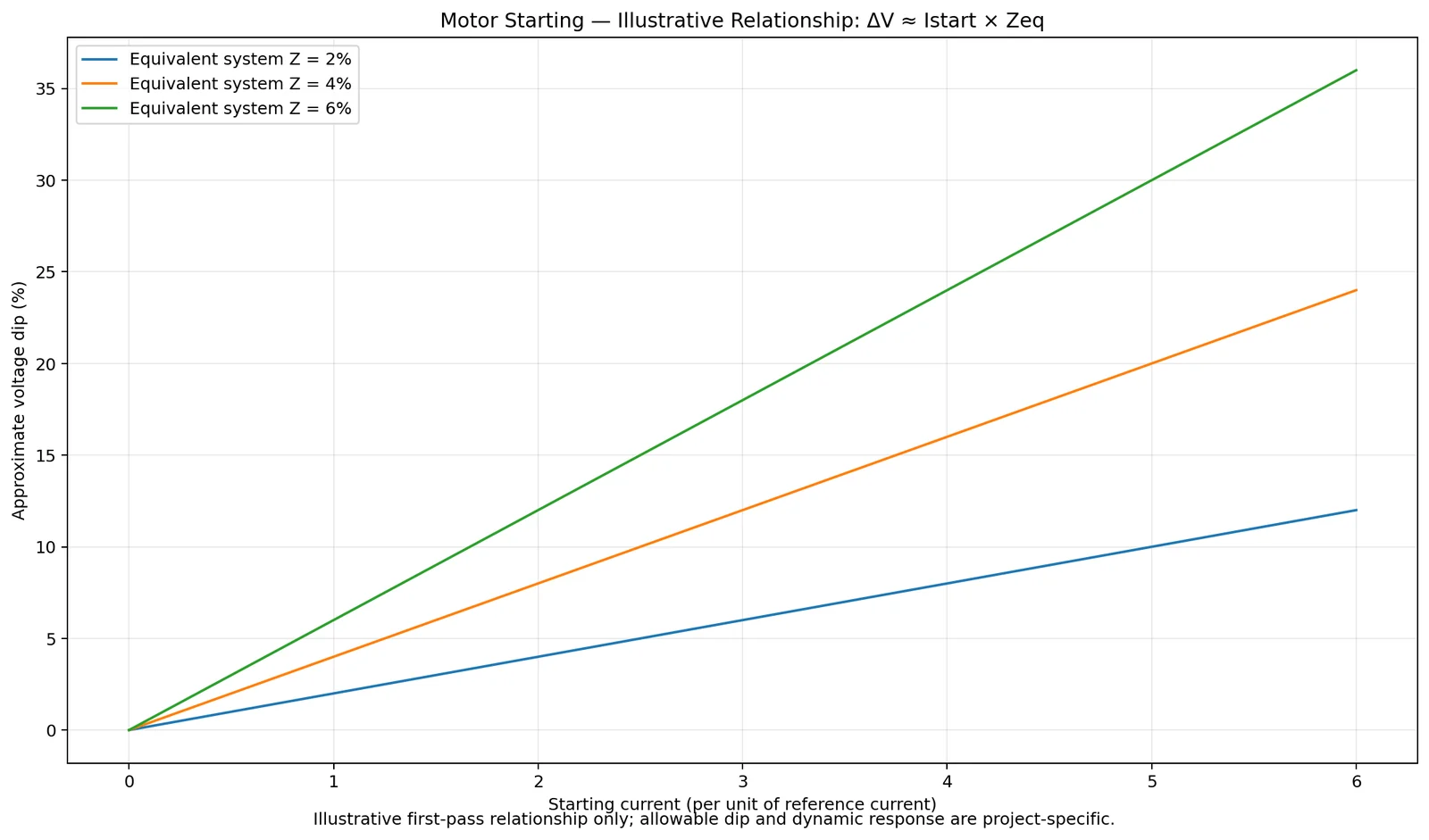
Voltage dip increases with starting current and equivalent source-system impedance in a first-pass model; allowable dip remains project-specific.
Why “steady-state kVA is enough” can still fail
- Motor starting is a short-duration dynamic event. Depending on the motor and starting method, current during acceleration can be materially higher than normal running current.
- That current flows through the equivalent source, transformer and feeder impedance, producing a temporary voltage change. A weaker source, higher total impedance or larger starting duty can make the dip more pronounced.
Do not publish one universal starting-current multiplier
- Engineering references often use approximate multiples of full-load current for preliminary discussion, but actual motors differ. A procurement decision should use motor manufacturer data such as locked-rotor current/code, starting-current curves, starter settings and acceleration time whenever available.
- The accompanying graph therefore uses per-unit starting current as an independent variable and labels the relationship as illustrative rather than claiming one fixed multiplier.
Starting method changes the duty
- Direct-on-line / across-the-line starting can impose a large current step on the source.
- A soft starter changes the voltage/current profile, with actual performance depending on settings and load torque.
- A VFD can control frequency and voltage during acceleration, while adding power-electronics and harmonic considerations.
- Star-delta or autotransformer starting can be appropriate in specific motor/system arrangements but must be checked against required starting torque and the electrical design.
Data required before a meaningful starting review
- Motor rated kW/hp, voltage and full-load current.
- Locked-rotor or starting-current data from the motor manufacturer.
- Starting method and control settings.
- Other loads that remain connected during the start.
- Acceptable voltage performance for sensitive loads and process equipment.
- Upstream short-circuit capacity or equivalent source impedance where available.
- Feeder/cable impedance and transformer percent impedance.
- Start frequency, duration and whether multiple motors can start together.
Use simplified equations as screening tools only
- A useful first-pass idea is that voltage dip is related to starting current multiplied by equivalent system impedance. The chart visualizes ΔV ≈ Istart × Zeq as a screening relationship.
- A real three-phase starting study may need source-impedance angle, cable data, transformer impedance, other connected loads, motor dynamics and protection behavior. TransformerGrid therefore does not promise that one transformer kVA will start one motor successfully from a single rule of thumb.
FAT and commissioning roles
- FAT can verify transformer impedance, ratio, winding connection and other specified parameters that feed into a motor-starting study.
- FAT cannot reproduce the customer’s actual utility source strength, feeder length, motor mechanical inertia or complete site load mix.
- At commissioning, the project team may verify actual pre-start and during-start voltage/current behavior where required, together with protection response and sensitive-load performance.
FAQ
Will buying the next transformer size up solve motor-starting problems?
It can change the impedance and capacity relationship, but it is not automatically the best solution. The source, feeder, starting method, protection and sensitive loads should be reviewed together.
Is motor starting current always 6–8 times full-load current?
No universal multiplier should be used for every motor. Use the actual motor and starter data.
Can FAT prove that the motor will start correctly on site?
FAT provides transformer parameters for the study, but it does not reproduce the complete site system.
Related Story from the Blog:
Buying or sourcing a transformer? Contact: sales@transformergrid.com