Technical Wiki · No. 3
Transformer Transport Shock and Shock Records: How to Decide After Arrival Whether Further Inspection Is Needed
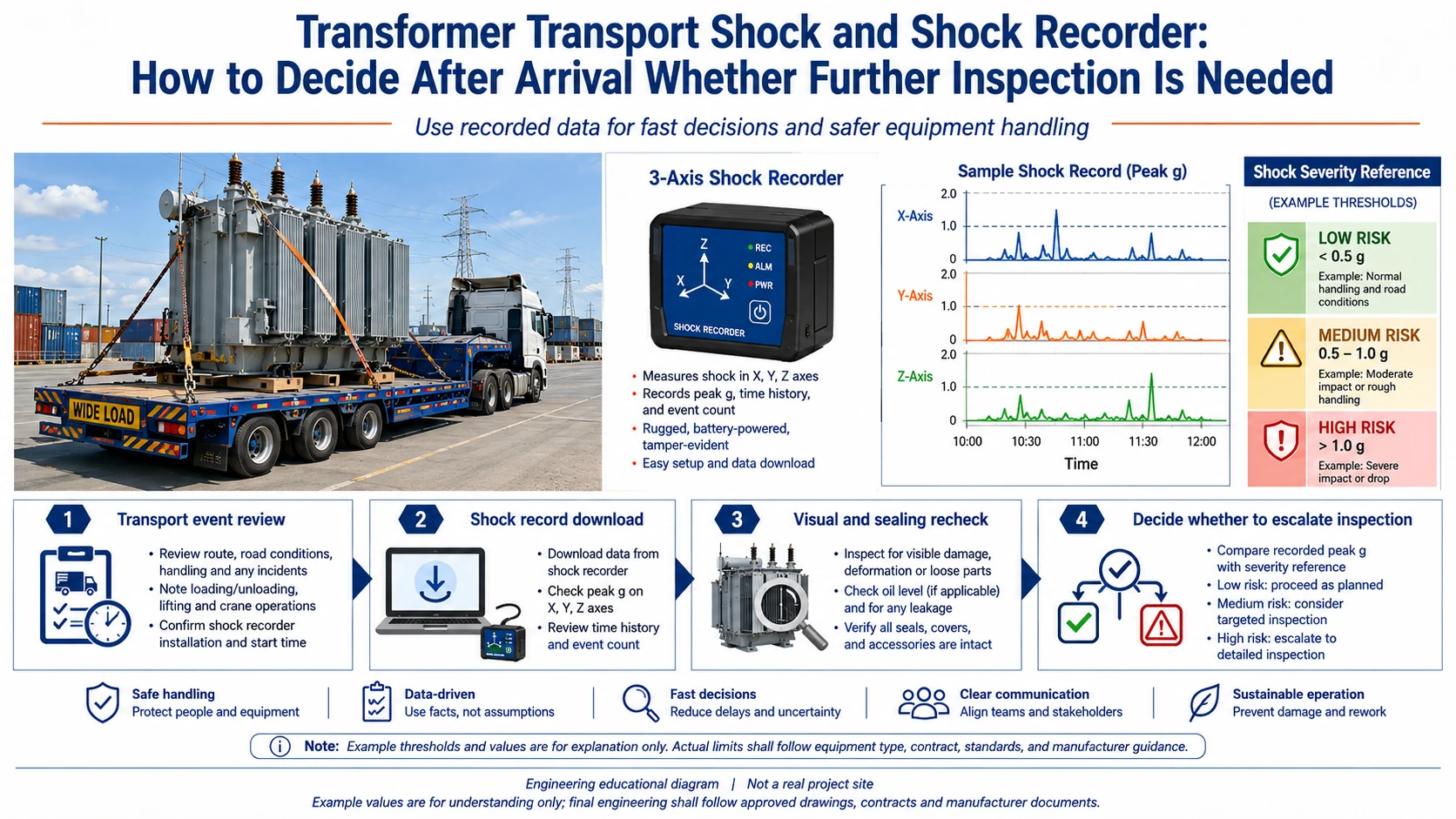
Why transport shock can be hidden
Large electrical equipment can experience vibration, acceleration, short-duration impact and repeated mechanical loading during road transport, port handling, lifting and transshipment. A short mechanical event can load internal supports or connections without creating an equally dramatic mark on the external tank.
Engineering references therefore treat vibration, shock, drop and collision as mechanical transport-environment factors. “No visible damage” is useful positive evidence, but it is not the whole conclusion.
What a shock recorder proves—and what it does not
Some large-transformer specifications require time-stamped multi-axis shock records. These records can show that a mechanical event occurred at a particular point in the journey and can help correlate the event with a route, lifting or transfer stage.
A shock recorder does not by itself prove that internal damage occurred, and it does not replace checks for leakage, package movement, loosened accessories, sealing condition or subsequent electrical/mechanical inspection. Recorder type, range, mounting location and acceptance criteria must be defined by the project and manufacturer.
How to review shock evidence after arrival
First verify that the recorder belongs to the correct transformer and that the time record is continuous. Second, correlate abnormal events with transport, lifting, transfer and handling records. Third, check whether the same time period is associated with visible deformation, leakage, shifted accessories or other abnormal observations. Fourth, have the manufacturer and project engineer determine whether targeted or detailed follow-up inspection is required.
Do not take a generic g-value from the internet and use it as a universal pass/fail threshold. Equipment design, recorder position, project specification and manufacturer limits all affect interpretation.
What this means for procurement documents
If transport shock is considered a material project risk, the PO or transport appendix should define the required recording method, record submission, event escalation, receiving-signature boundary and manufacturer response. Without those rules, a project can receive an abnormal curve and still have no agreed decision path.
Frequently Asked Questions
Can a transformer be accepted without a shock recorder?
Yes, if the project does not require one. Shock recorders are not a universal requirement for every transformer. Follow the contract, manufacturer transport instructions and project standards.
Does exceeding one shock value automatically mean the transformer must return to the factory?
No. Limits, recorder range, mounting position, transformer construction and project criteria all affect the decision. An abnormal event should enter a manufacturer/project-engineer assessment process.
If the transformer looks completely normal, can installation start immediately?
A normal appearance is positive evidence, but sealing, accessories, documents, transport records and the project-defined receiving checks should also be reviewed.
Technical References
- Qin Ganghua, Wang Zhanhong, Wang Xin, et al.. 《火力发电企业绝缘技术监督手册》 [Insulation Technical Supervision Manual for Thermal Power Enterprises]. Zhejiang University Press, 2021. Consulted for transformer transport/storage, arrival control, installation and handover-test boundaries.
- Editorial Board of Electrical Engineer Handbook, 4th ed.; Wang Jianhua, ed.. 《电气工程师手册(第4版)》 [Electrical Engineer Handbook, 4th Edition]. China Machine Press, 2024. Consulted for shock, vibration, humidity and transport/storage mechanical-environment factors.
Project-specific limits, inspection criteria, test sequence, protection settings and commissioning decisions require written confirmation from the applicable project specification, owner or utility, manufacturer and responsible engineer.