Technical Wiki · No. 4
Transformer Site Receiving Inspection: Appearance, Sealing, Accessories, Transport Records and Evidence Chain
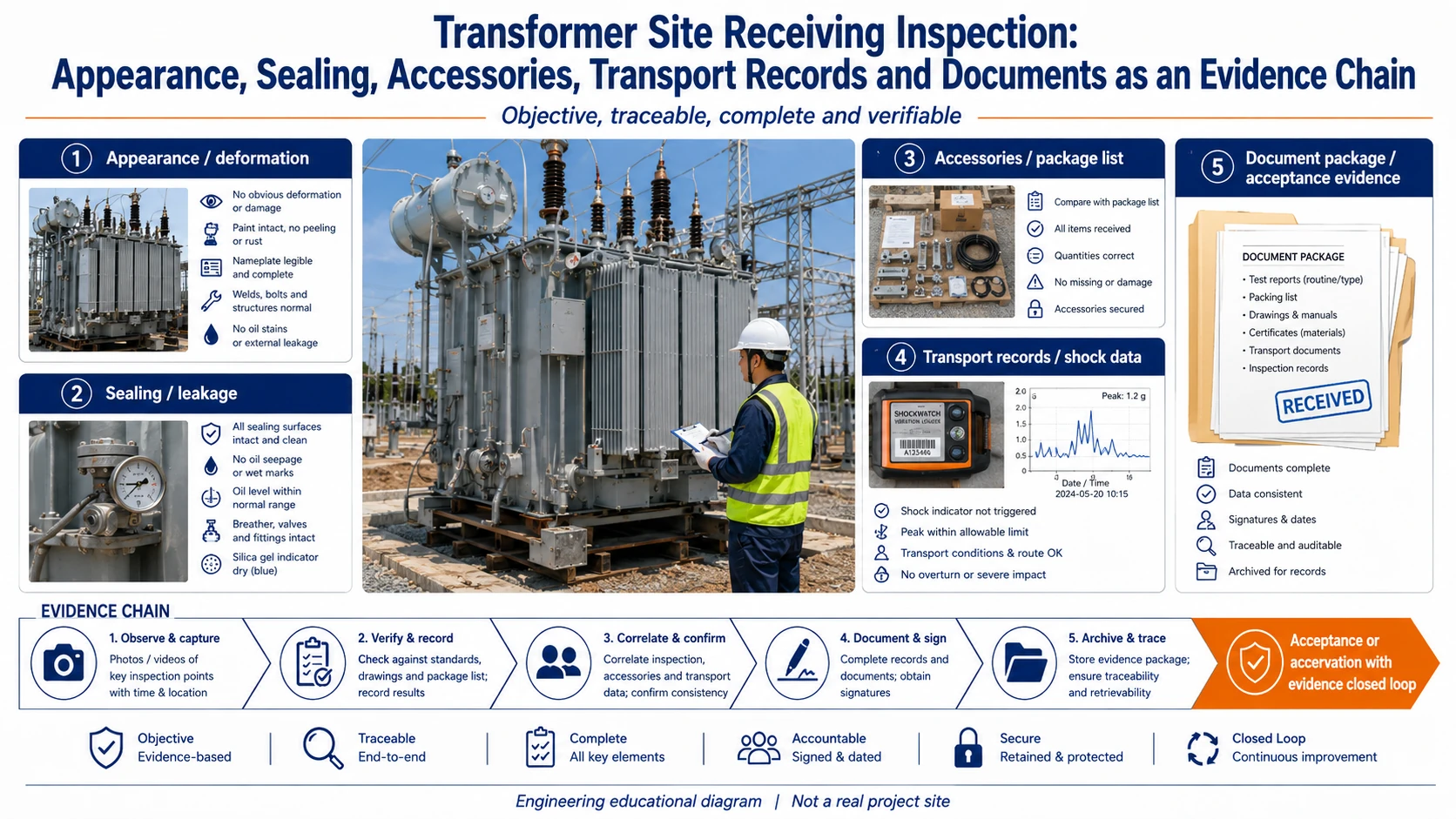
Layer 1 — transformer body and visible condition
Record the condition of the tank, radiators, bushing interfaces, valves, instruments, terminal boxes, paintwork and exposed accessories before installation activity changes the scene. If deformation, leakage, impact damage, displaced parts or broken packaging are found, create written and photographic evidence before proceeding.
For accessories shipped separately, reconcile the individual crates against the package list. A missing or delayed accessory can affect the installation sequence even when the main transformer appears normal.
Layer 2 — sealing and preservation state
For oil-immersed equipment, sealing condition is part of insulation-system management. The site team should not look only for obvious oil leakage; it should also verify the project-defined preservation, pressure, sealing or transport condition where applicable.
If an abnormal state is found, avoid uncontrolled opening, gas addition or oil addition before the original condition is recorded and the manufacturer has given appropriate guidance. Otherwise the site action itself may destroy useful evidence or introduce a new variable.
Layer 3 — transport evidence and factory documents
The receiving package should correlate the transformer identity with the packing list, factory certificate, factory/FAT reports, approved drawings and project-required transport or shock records. Complete documents do not prove that the transformer is undamaged, but missing or mismatched documents remove the baseline needed for later technical judgment.
Multi-package and international shipments especially benefit from clear links among serial numbers, crate numbers, equipment tags and the final shipping list.
Layer 4 — close abnormalities through a documented path
A stronger process follows “find → record → isolate the impact → manufacturer/project review → additional inspection or test if needed → written closure.” That process protects both buyer and manufacturer because the decision can be reviewed against evidence rather than memory or verbal assumptions.
Frequently Asked Questions
If there is no oil leak at arrival, can the delivery be signed as “in good condition”?
Do not base the decision on leakage alone. Review appearance, sealing, packages, transport records and key documents, then sign in accordance with the project receiving procedure and the condition actually observed.
Can the team sign first and take photos later?
From an evidence-management standpoint, record the condition before additional handling or installation changes the scene.
How is site receiving different from a port inspection?
A port inspection often focuses on import handover and initial visible condition. Site receiving must continue the chain into installation readiness, package identity, project documents and abnormal-condition closure.
Technical References
- Qin Ganghua, Wang Zhanhong, Wang Xin, et al.. 《火力发电企业绝缘技术监督手册》 [Insulation Technical Supervision Manual for Thermal Power Enterprises]. Zhejiang University Press, 2021. Consulted for transformer factory acceptance, transport/storage, site installation, handover testing, operation and document-control boundaries.
- Sun Kejun, ed.; Jing Chenghao, Wang Zhongjie, Sun Huiqin, assoc. eds.. 《电工手册》 [Electrical Engineering Handbook]. China Machine Press, 2022. Consulted for oil-immersed transformer pre-service inspection, trial operation, protection confirmation, cooling and operating observation.
Project-specific limits, inspection criteria, test sequence, protection settings and commissioning decisions require written confirmation from the applicable project specification, owner or utility, manufacturer and responsible engineer.