Procurement & Engineering
The Quote Said “Accessories Complete”—Yet Eight Critical Questions Were Still Unanswered
A procurement scenario showing why “standard accessories included” is not an acceptance-ready transformer specification and how to structure the accessory, signal, control and FAT matrix.
The meeting that almost ended in ten minutes
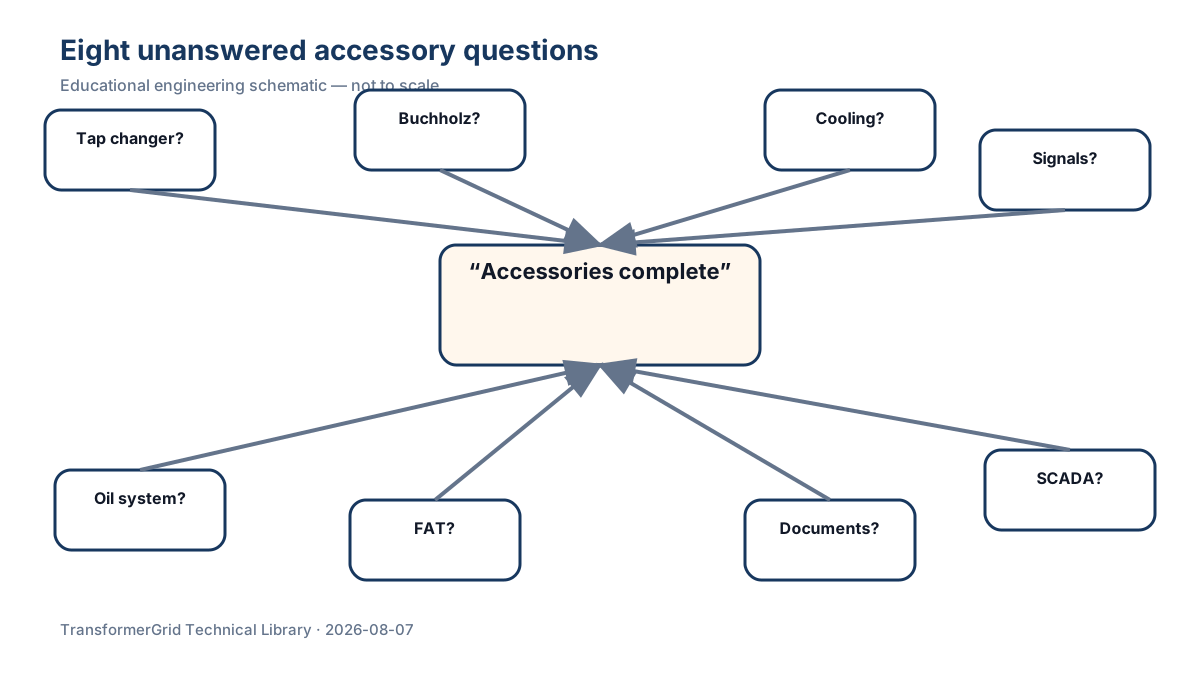
Project manager Mateo received three transformer quotations. The main parameters looked complete: rating, voltage, impedance, losses and delivery time were all there. In the accessories column, however, each offer used one sentence: “standard accessories included.” The lowest bidder was meaningfully cheaper than the second. After ten minutes, the team was close to selecting it—until the electrical consultant asked eight questions: Is the tap changer de-energized or on-load? How are the Buchholz contacts assigned? Does the pressure-relief device only alarm or participate in another protection action? Does the conservator use a bladder? How many cooling groups are there? Does the oil-pump circuit have a standby supply? What signals do WTI and OTI provide? Should the oil-level alarm be mapped into SCADA? The room went quiet.
Why the risk is larger than the accessory price
The problem is not that every one of these accessories is expensive. The problem is that they cross mechanical, primary electrical, secondary wiring, control, civil, fire-protection and maintenance interfaces. One undefined contact may surface only during FAT. One undefined pump supply may force the control-cabinet drawings to be revised. One undefined conservator arrangement may change transport and field assembly. “Accessories complete” is not an acceptance criterion unless it is backed by a schedule, signal list and drawings.
The technical reason these items cannot be separated
The accessories of an oil-immersed power transformer form five systems: voltage regulation, oil preservation, mechanical protection, cooling, and monitoring/control. They interact. Cooling-pump operation can influence oil flow; a Buchholz operation must be correlated with DGA; an abnormal oil level may be caused by temperature, leakage, breathing or a bladder issue; temperature contacts can start fans and generate alarms. Treating these as small questions to be solved after purchase often pushes the risk into drawing approval, FAT or the site.
How TransformerGrid structures the interface
At RFQ stage, TransformerGrid can convert one line saying “standard accessories” into a comparable accessory matrix: function, make/model, quantity, location, signals, control supply, alarm/trip duty, testing and documents for each device. During drawing review, the same information is maintained through revision control and a deviation list. During FAT, terminals and signal points are checked against the approved schedule. TransformerGrid is an independent export and engineering-coordination brand; manufacturing is performed by verified partners. Verified partner records include 99 export orders in 2025 across more than 26 countries and regions, with individual records up to 336 MVA and 230 kV. Those figures belong to the manufacturing partner’s documented experience and are not presented as TransformerGrid-owned manufacturing history.
Action checklist before the RFQ is released
At minimum, submit the main parameter sheet, accessory schedule, protection and signal matrix, cooling rating stages, control supplies, communication interface, site environment, FAT requirements, spares and document language. TransformerGrid does not choose protection setpoints on behalf of the owner. The goal is to make unanswered questions visible before the order—not before energization.
Turn “accessories complete” into an acceptance-ready schedule
Send the main parameter sheet, accessory schedule, single-line diagram and protection/signal requirements. TransformerGrid can organize function, make/model, quantity, terminals, control power, alarm/trip duty, tests and documents into one deviation matrix for quotation, drawing review and FAT.