Technical Wiki · No. 6
Transformer Installation Preparation: Foundation, Grounding, Bushings, Accessories and Cable Interfaces
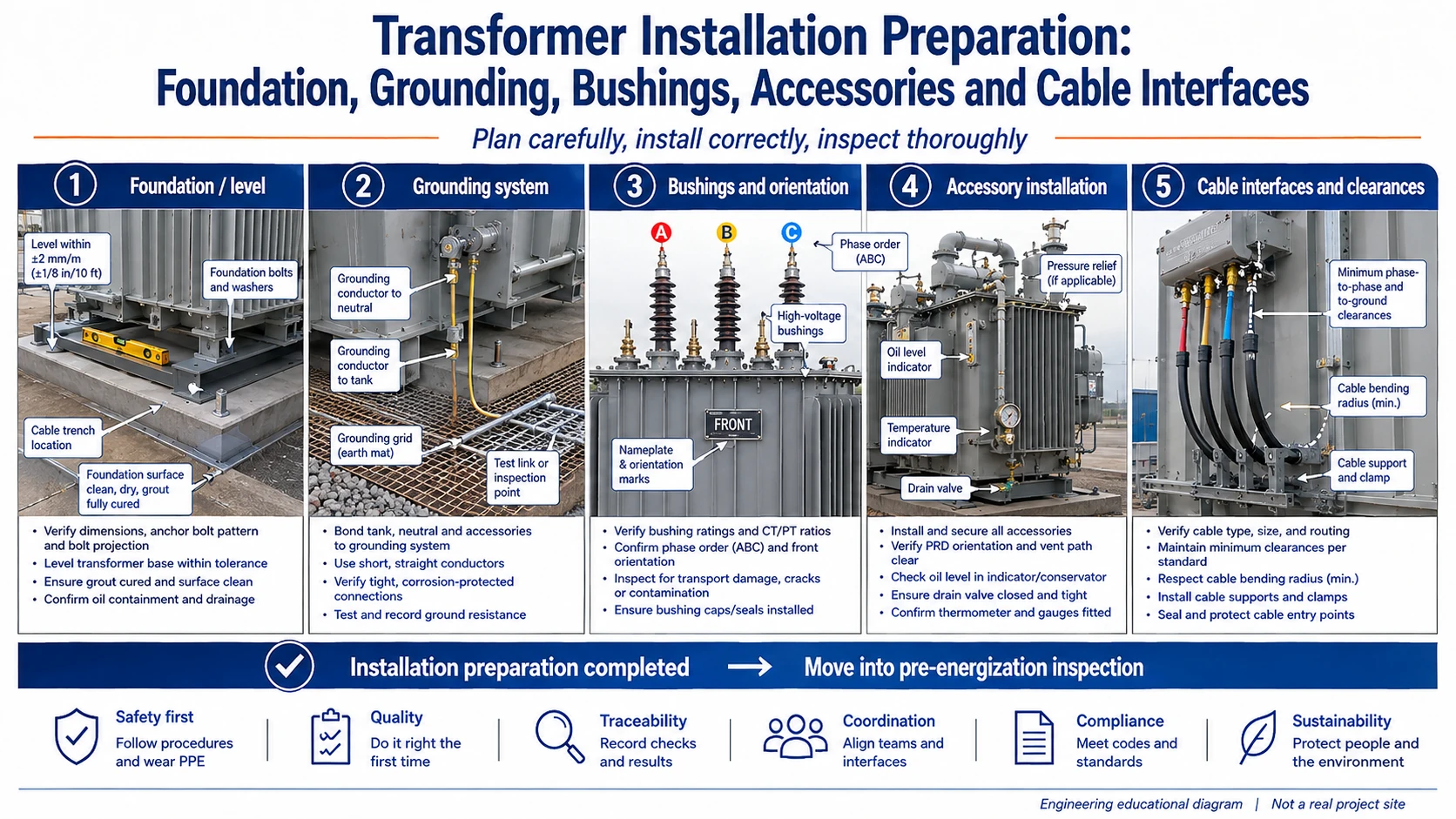
Reconcile the foundation and equipment arrangement first
The GA drawing, foundation drawing, anchor points, equipment orientation, maintenance side and lifting path should all be based on the same approved revision. For pad-mounted equipment, cable conduits and trench directions also need to align with the HV and LV compartments.
This page focuses on cross-discipline interface control rather than replacing detailed civil-design or cable-bending-radius calculations.
Grounding and primary electrical interfaces cannot be left until the end
Grounding-terminal locations, system-grounding concept, neutral connections, surge-protection interfaces and primary cable terminations must agree with the one-line and approved design. A dangerous mismatch does not always look like “the cable will not fit”; sometimes it fits mechanically while violating the intended electrical arrangement.
Review the transformer drawing, one-line and grounding design together before installation begins.
Bushings, accessories and transport-removed parts need a closed installation loop
Bushings, radiators, instruments, breathers and other accessories removed for transport should be reassembled, sealed, connected and checked according to manufacturer instructions. Mechanical installation alone is not closure: associated valves, terminals, signal wiring and fastening status must feed into the pre-energization checklist.
Control and auxiliary-power interfaces are part of installation too
Fans, pumps, heaters, temperature control, alarm/trip contacts and remote signals can require auxiliary power and control wiring. Completing the main power connection while leaving these interfaces unresolved can create a transformer that is electrically connected but not ready to be safely monitored, cooled or protected.
Frequently Asked Questions
Is installation preparation mainly a foundation-dimension check?
No. Civil alignment is one part; electrical connection, grounding, accessories, controls and auxiliary interfaces must also be reconciled.
If the manufacturing drawings were approved, is a site recheck still needed?
Yes. Approved drawings are the design baseline; the site recheck confirms that actual civil, cable and installation conditions have not deviated from that baseline.
Does this guide replace construction and acceptance standards?
No. Specific installation methods, torque, vacuum/oil work, testing and safety controls must follow the applicable project standards and manufacturer documents.
Technical References
- Qin Ganghua, Wang Zhanhong, Wang Xin, et al.. 《火力发电企业绝缘技术监督手册》 [Insulation Technical Supervision Manual for Thermal Power Enterprises]. Zhejiang University Press, 2021. Consulted for transformer supervision across manufacturing, factory acceptance, transport/storage, site installation, handover testing, operation and technical records.
- Sun Kejun, ed.; Jing Chenghao, Wang Zhongjie, Sun Huiqin, assoc. eds.. 《电工手册》 [Electrical Engineering Handbook]. China Machine Press, 2022. Consulted for oil-immersed transformer pre-service checks, trial operation, protection confirmation, cooling and operating observation.
- Editorial Board of Electrical Engineer Handbook, 4th ed.; Wang Jianhua, ed.. 《电气工程师手册(第4版)》 [Electrical Engineer Handbook, 4th Edition]. China Machine Press, 2024. Consulted for transport/storage environmental factors, humidity, shock, vibration and mechanical-environment effects on electrical equipment reliability.
Project-specific limits, inspection criteria, test sequence, protection settings and commissioning decisions require written confirmation from the applicable project specification, owner or utility, manufacturer and responsible engineer.