The Crate Looked Perfect. The Shock Recorder Told a Different Story
Paired technical guide: transport shock and shock-record review
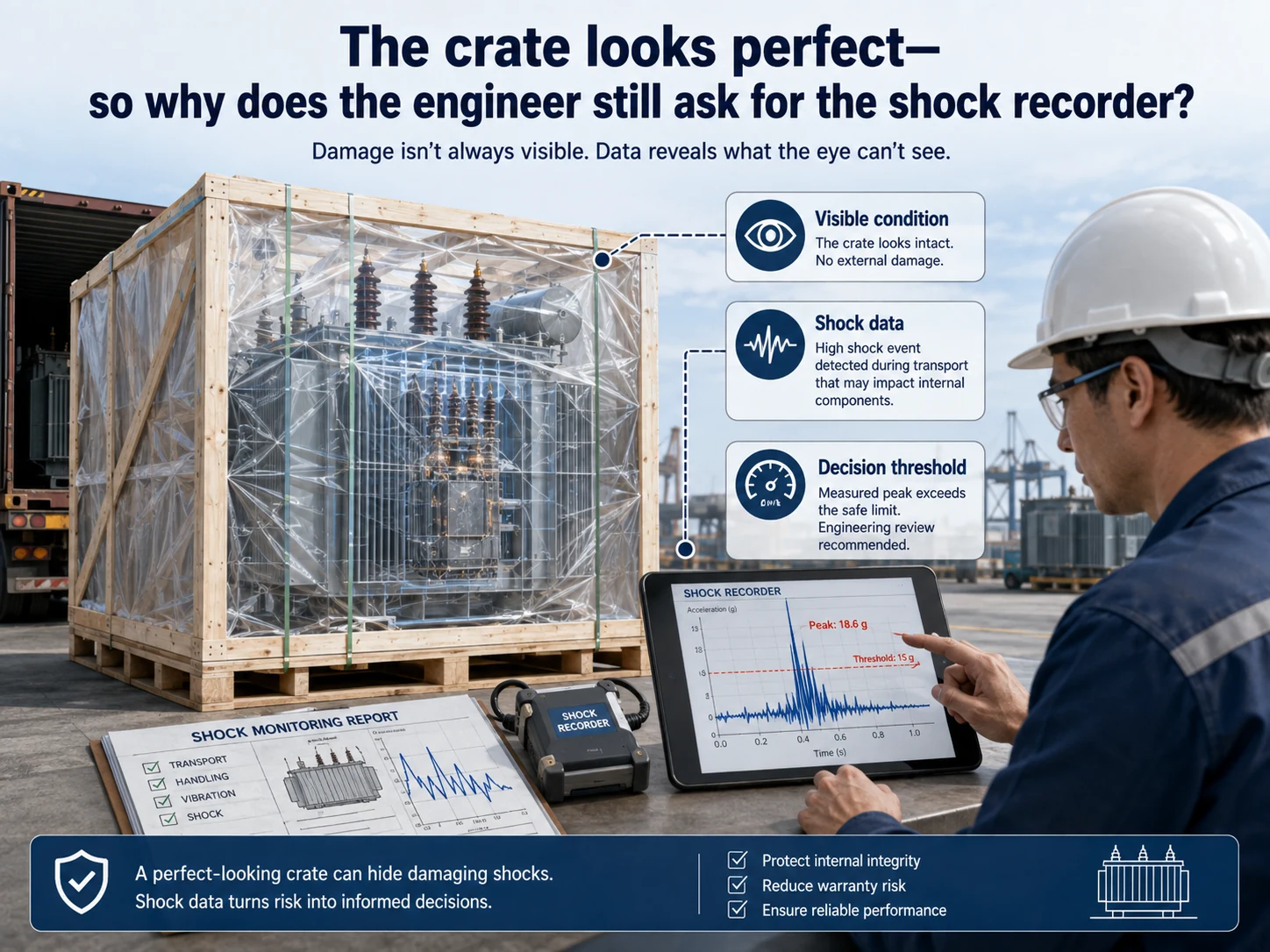
What happened — and why it matters
When the heavy-haul trailer finally arrived, everyone relaxed. The shipping protection looked intact. There was no obvious tank deformation, no torn packaging and no visible damage around the protected bushings. Leo, the site quality manager, did not sign the receiving sheet. He walked to the side of the transformer and asked the carrier, “Who is downloading the shock recorder?” The driver looked surprised. “The unit looks fine. Why do you need that?”
The technical backbone is the transport shock and shock-record review. Visual inspection answers one question: what can we see now? Transport records answer another: what happened before now? A large transformer can experience braking events, potholes, transfer lifts, set-down impacts, slope changes and prolonged vibration during a long journey. Some mechanical events leave visible marks. Others may not. A shock recorder is valuable because it reconstructs part of a timeline that human eyes cannot replay.
The correct response is neither panic over a single peak nor blind trust because no alarm light is obvious. The engineering team should first confirm recorder location, orientation and time reference. Then review event time, peak values by axis, duration and the corresponding transport segment. Those data should be compared with route logs, lifting or transfer records, driver or carrier incident notes, and the limits or decision rules specified by the manufacturer or project. If something is abnormal, the inspection scope can be escalated. If nothing is abnormal, the data still belong in the arrival evidence package.
Two procurement clauses are especially weak. The first says only, “Transport with care.” The second requires “a shock recorder” but says nothing about who activates it, who reads it at destination, what data format must be handed over, or what happens after a trigger. A recorder without a responsibility process is a black box with a memory and no interviewer.
Leo did not reject the transformer because one number looked dramatic. He did something more useful: he placed the shock data, external inspection, sealing condition and transport timeline into one abnormality review. Procurement value does not come from finding a frightening g-value. It comes from turning an invisible journey into evidence that can support a rational next decision.
Technical deep dive
Continue with the paired Wiki: transport shock and shock-record review
Project Action
If the project requires a shock recorder, do not stop at “provide one.” Define activation, download, data handover, abnormal-event escalation and responsible parties in the transport plan.
Selected for State Grid projects. Proven across extreme climates.
Manufacturing experience backed by documented project awards through a verified manufacturing partner.
Buying or sourcing a transformer? Contact:
WhatsApp: +86 176 8746 9988