The New Transformer Was Bigger. Why Did the Old One Overload First?
“Buy bigger and you cannot go wrong” is a tempting procurement rule
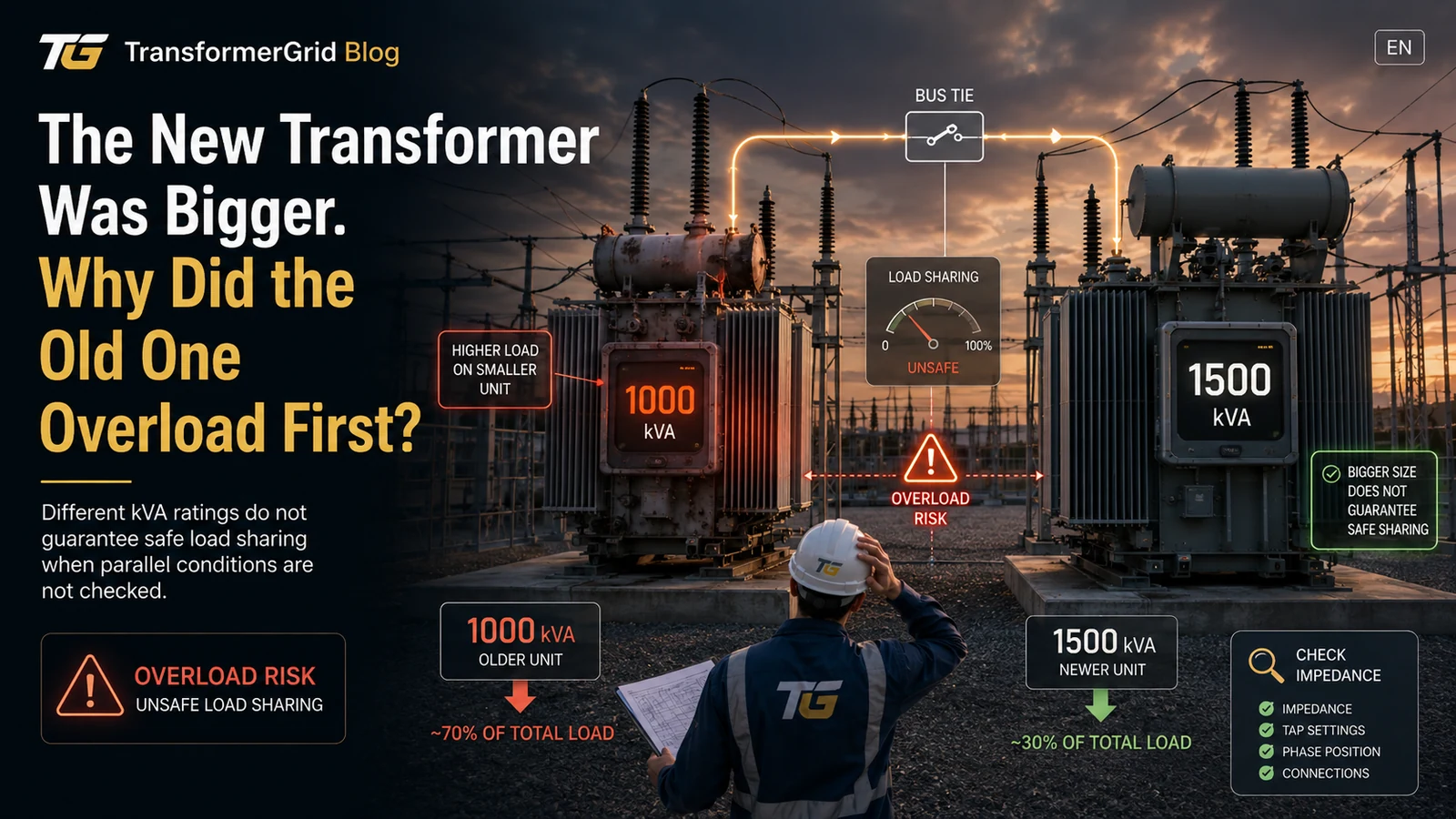
A customer had a 1000 kVA transformer and wanted a 1500 kVA unit for an expansion. The logic sounded perfect: the new transformer would be larger and leave room for future load.
If the units were going to operate separately, that might be the end of the conversation. Then the customer added one sentence: “We want them to run in parallel long term.”
TransformerGrid immediately stopped thinking only about the price of a 1500 kVA transformer. We started thinking about how a 1000 and a 1500 kVA transformer would actually share the system load.
We do not worship bigger nameplates
Parallel load sharing does not simply allocate current according to the kVA printed on the doors. Capacity, per-unit impedance, actual ratio and system conditions work together.
A larger new transformer can still produce a counterintuitive outcome: plenty of unused capacity on the new unit while the older, smaller unit approaches overload.
That is why TransformerGrid will not answer “no problem” just because the buyer selected a larger rating. We want to know how the two machines will work as a pair.
Why we do not always tell the customer what they want to hear
The easiest sales sentence is: “Go bigger. It is safer.”
When the project requires continuous paralleling, we bring capacity ratio, %Z, tap, protection and bus operating condition into the review.
Customers may occasionally find us annoying because we keep asking about the old transformer and the real operating scenario. In industrial projects, one extra question before production is usually cheaper than one hundred explanations after energization.
What we really sell is a little more certainty
TransformerGrid is not an insurance company and we do not promise that the world has no surprises. Our job is to move uncertainty forward where possible.
Does the larger unit create useful capacity? How will the pair share load? Could the existing transformer remain the bottleneck? The more of that we can clarify before procurement, the better.
Bigger does not mean better load sharing. That is the line to remember.
Why this matters to the buyer
You are not buying the words “1500 kVA.” You are buying how that unit will work beside the existing system for years.
A few thousand dollars of price difference is obvious. Persistent load imbalance, heating, protection complications and blocked expansion capacity are much less visible.
TransformerGrid tries to put those invisible costs on the table before the PO.
Why buyers remember TransformerGrid
- We review the existing system, not only the new nameplate.
- We surface open technical items before production whenever possible.
- We coordinate manufacturing-side drawings and data through a verified manufacturing partner.
- We do not replace the EPC or consultant; we make their review easier with better-organized inputs.
Project Action
For 1000+1500, 1500+2000 or different-brand/different-age transformers expected to parallel, do not send only the new rating. Send the existing kVA, %Z, tap, connection, one-line diagram and planned load. TransformerGrid can identify which compatibility points must enter the technical confirmation.
Selected for State Grid projects. Proven across extreme climates.
Manufacturing experience backed by documented project awards through a verified manufacturing partner.
Buying or sourcing a transformer? Contact:
WhatsApp: +86 176 8746 9988