Different kVA Transformers in Parallel: Capacity Ratio, Per-Unit Impedance & Overload Risk
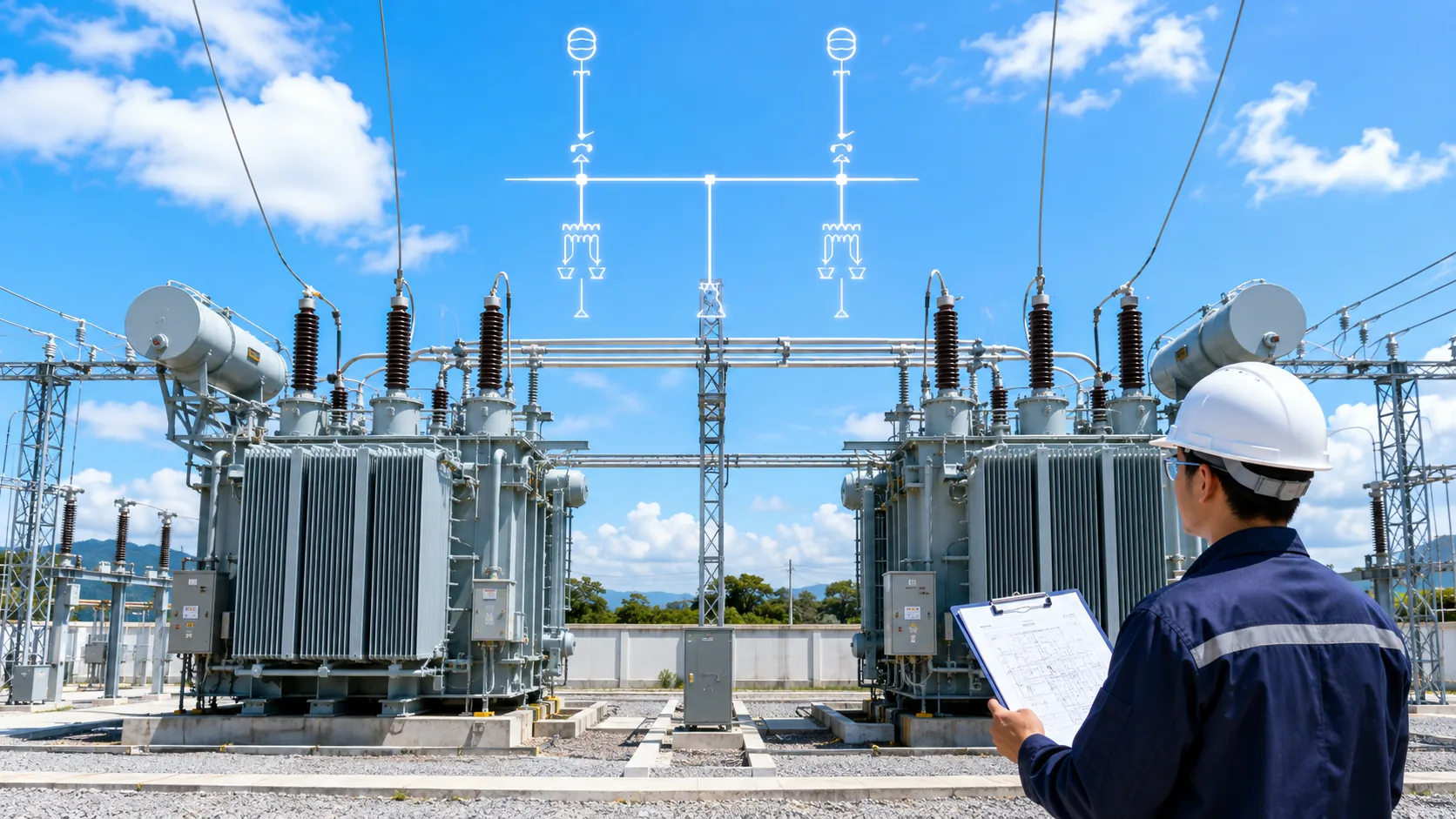
Why a larger transformer does not always carry more load
If the two units have the same %Z, load weight tends to follow rated kVA. For example, 1000 kVA and 1500 kVA units both at 5% Z have S/Z weights of 200 and 300, close to the 40/60 capacity ratio.
If impedance differs, the capacity advantage can be cancelled. A 1000 kVA unit at 4% Z has weight 250; a 1500 kVA unit at 6% Z also has weight 250. They tend toward a 50/50 split. At 2400 kVA total, each would carry roughly 1200 kVA, overloading the smaller transformer while the larger still has headroom.
Why a capacity-ratio rule cannot replace calculation
Older operating references may use capacity-ratio limits as practical guidance. Actual projects differ in impedance design, standards, cooling, age and operating philosophy. Use ratio as a trigger for deeper review, then calculate with actual transformer data.
Continuous parallel operation versus transfer-only operation
Long-term paralleling requires stable sharing, losses, temperature, voltage regulation and protection coordination. Short-duration transfer or contingency operation may use different duration and emergency-loading limits. The RFQ should state the intended operating mode, not merely “parallel capable.”
Five-step engineering decision
1. Confirm hard voltage/phase compatibility. 2. Calculate S/%Z load weights at maximum planned load. 3. Check current, thermal and cooling margin. 4. Revisit fault-current and protection impact. 5. Confirm tap/control and operating philosophy.
Only after these steps can “different kVA units may operate in parallel” become a project conclusion rather than a rule of thumb.
Procurement / engineering execution checklist
| Role | Core information / action |
|---|---|
| Buyer / EPC | Both kVA ratings, %Z, operating mode, max continuous/emergency load, cooling and ambient assumptions. |
| Supplier | Rated capacity, guaranteed/measured %Z, cooling/temperature-rise capability and relevant test data. |
| Site / Operations | Confirm actual load split, smaller-unit margin, temperatures and protection trends. |
The New Transformer Was Bigger. Why Did the Old One Overload First?
Frequently Asked Questions
Can 1000 kVA and 1500 kVA transformers operate in parallel?
Possibly, but voltage, phase, impedance, grounding and protection must be compatible and the load split must be calculated.
Will the larger unit always carry more load?
No. Higher percent impedance can make the larger unit carry less than its capacity proportion.
Is total load below the sum of the two nameplate kVA always safe?
No. Unequal sharing can overload one transformer first.
- Power Transformers and Protection Q&A — operation, paralleling, ratio, vector group, impedance and inrush chapters
- Electrical Engineer’s Handbook, 4th ed. — system connection, transformer impedance and substation engineering
- Relay Protection Technical Supervision Manual — transformer inrush, differential protection and commissioning checks
- Fundamentals of Power Systems — neutral grounding and transformer zero-sequence networks
This article is an engineering and procurement guide. Final paralleling, protection, grounding and switching decisions must follow the project one-line, applicable standards, utility requirements and authorized engineering/commissioning procedures.