Two 1500 kVA Transformers. Why Was One Carrying More Load?
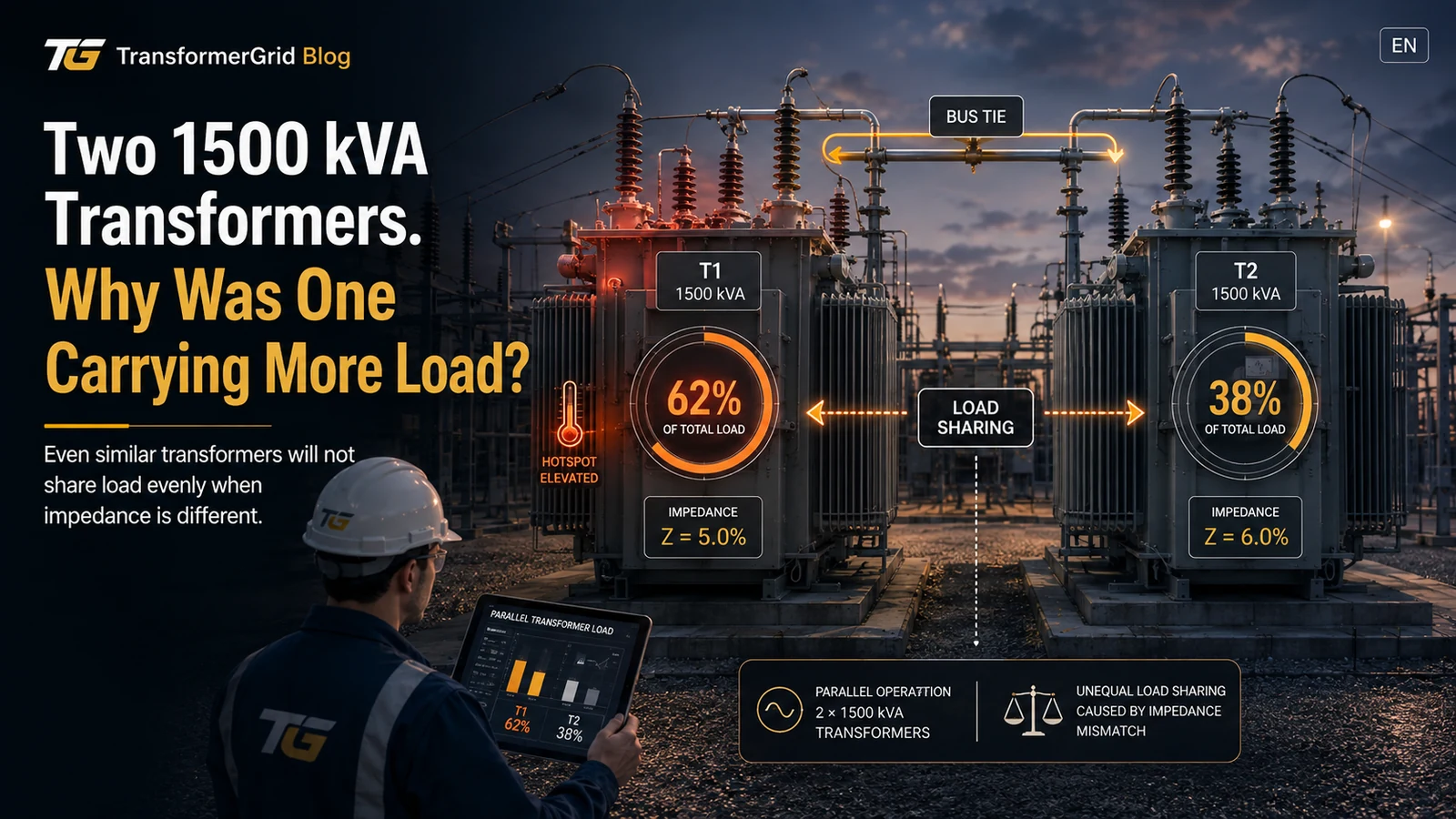
Buyers love 50/50. The system does not promise it
Put two 1500 kVA transformers in parallel and the natural assumption is simple: 3000 kVA total, half of the load on each unit.
Then one transformer approaches full load while the other still looks comfortable. The team starts questioning CTs, meters, temperature indication, even the quality of the new transformer.
TransformerGrid asks a less visible question first: are the two percent-impedance values actually compatible?
Why impedance matters to us before the PO
Impedance is not only a short-circuit-study number. In parallel operation it also influences how current is shared.
Same kVA does not automatically mean 50/50. If impedances differ, the lower-impedance unit can take a larger share of the load.
The formulas belong in engineering calculations. The buyer’s memory line is easier: same kVA does not mean same workload.
Price is easy to compare. %Z is harder — so we compare it
Procurement naturally compares price, lead time and dimensions. Percent impedance sits quietly on a data sheet.
TransformerGrid pulls that quiet number into the conversation because the customer does not really need the lowest line on a quotation. The customer needs equipment that divides the job correctly inside the system.
When a new transformer must parallel an older unit for long periods, we look at both units’ %Z, kVA, taps, connections and operating scenario rather than approving the new data sheet in isolation.
We keep the technical mess on our side
A customer can chase old reports, calculate load sharing, ask why the manufacturer proposed a different impedance and coordinate every open question separately.
TransformerGrid’s value is to turn the technical mess into questions the manufacturer can answer, the consultant can review and procurement can make decisions from.
We are not making the engineering more complicated. We are organizing the complexity so it becomes usable.
The number you should compare is not only unit price
One transformer may be slightly cheaper but cause the existing unit to carry an uncomfortable share of load for years. Another may cost more but fit the existing system better. Which one is cheaper?
Industrial equipment often hides the answer outside the quotation table.
TransformerGrid wants to help buyers see that part.
Why buyers remember TransformerGrid
- We review the existing system, not only the new nameplate.
- We surface open technical items before production whenever possible.
- We coordinate manufacturing-side drawings and data through a verified manufacturing partner.
- We do not replace the EPC or consultant; we make their review easier with better-organized inputs.
Project Action
If you are adding or replacing one transformer in an existing parallel pair, send both units’ rated kVA, %Z, ratio/tap, connection and expected parallel operating condition. TransformerGrid can organize the load-sharing risk points and manufacturing-side confirmation items.
Selected for State Grid projects. Proven across extreme climates.
Manufacturing experience backed by documented project awards through a verified manufacturing partner.
Buying or sourcing a transformer? Contact:
WhatsApp: +86 176 8746 9988