Vector Group, Phase Displacement, Polarity & Phase Sequence for Parallel Transformers
What vector group actually communicates
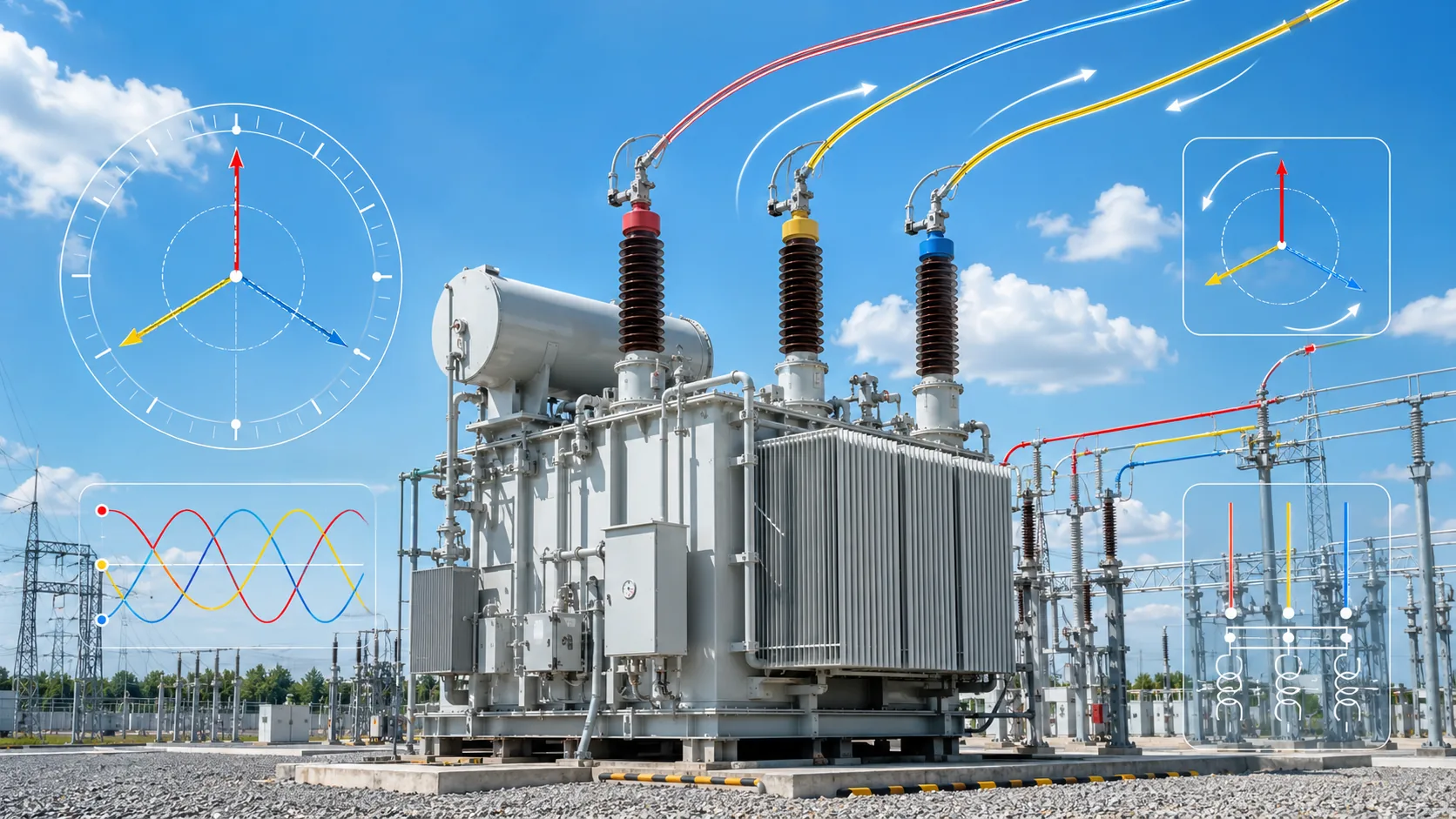
Vector-group notation captures winding connection and phase displacement, and may also indicate whether a neutral is brought out. For paralleling, the essential issue is the phasor relationship at the intended common bus—not whether two nameplate codes look similar.
Why Dyn11 versus Dyn1 is a hard compatibility issue
Each clock hour represents 30 degrees. Moving from 11 to 1 crosses two clock positions, a 60-degree difference. Connecting sources with that phase mismatch is not a small load-sharing issue; it is a major phasor conflict.
Treat clock number / phase displacement as a stop-check item before procurement is finalized.
How to handle North American connection notation
North American project documents may describe Delta-Wye, Wye-Wye, polarity, phase rotation and terminal diagrams instead of an IEC vector-group code. The engineering objective is the same: prove that the phase voltages presented at the common bus can be connected in phase.
For cross-market procurement, translate factory notation into the project-approved connection and phasor drawings instead of relying on terminology alone.
FAT versus field verification
Factory ratio/connection tests and terminal drawings show whether the transformer was manufactured to the approved connection. They do not prove that site cables, terminal labels and switchgear phase identification were installed correctly.
Complete phase-sequence and phase checks at the actual bus-tie point before paralleling.
Procurement / engineering execution checklist
| Role | Core information / action |
|---|---|
| Buyer / EPC | Existing connection/vector group, phasor diagram, required phase sequence, terminal identification and one-line. |
| Supplier | New connection/vector group, polarity/phase-displacement diagram, terminal drawing and connection-test evidence. |
| Site / Commissioning | Confirm terminal phase labels, phase sequence and phase relationship across the bus tie. |
Dyn11 and Dyn1 Looked Close. Why Did We Stop the Quote?
Frequently Asked Questions
What is the phase-displacement difference between Dyn11 and Dyn1?
Two clock hours, or 60 degrees.
Is matching ABC phase sequence enough?
No. Polarity/phase displacement, ratio/taps, impedance, grounding and protection must also be compatible.
Is a field phase check still needed after a successful FAT?
Yes. FAT validates the transformer; the field check validates the installed paralleling point.
- Power Transformers and Protection Q&A — operation, paralleling, ratio, vector group, impedance and inrush chapters
- Electrical Engineer’s Handbook, 4th ed. — system connection, transformer impedance and substation engineering
- Relay Protection Technical Supervision Manual — transformer inrush, differential protection and commissioning checks
- Fundamentals of Power Systems — neutral grounding and transformer zero-sequence networks
This article is an engineering and procurement guide. Final paralleling, protection, grounding and switching decisions must follow the project one-line, applicable standards, utility requirements and authorized engineering/commissioning procedures.