The Transformer Passed FAT. Why Did the Project Risk Start After It Left the Factory?
Paired technical guide: complete engineering lifecycle from factory release to first energization
What happened — and why it matters
On a Friday afternoon, an EPC project manager named Daniel received the email he had been waiting for: FAT passed, the reports were signed, and the transformer was released for shipment. He typed one sentence into the project chat: “The hardest part is over.” Three weeks later, that message felt painfully optimistic. Nothing had “failed” at the factory. The delay came from somewhere else. One accessory crate was separated during port handling. The civil foundation was handed over twelve days late. The transformer arrived before the site was ready and had to be stored. When the installation crew finally mobilized, the control-cable interface schedule did not fully match the latest approved drawing revision. Each issue looked manageable on its own. Together, they pushed the energization date.
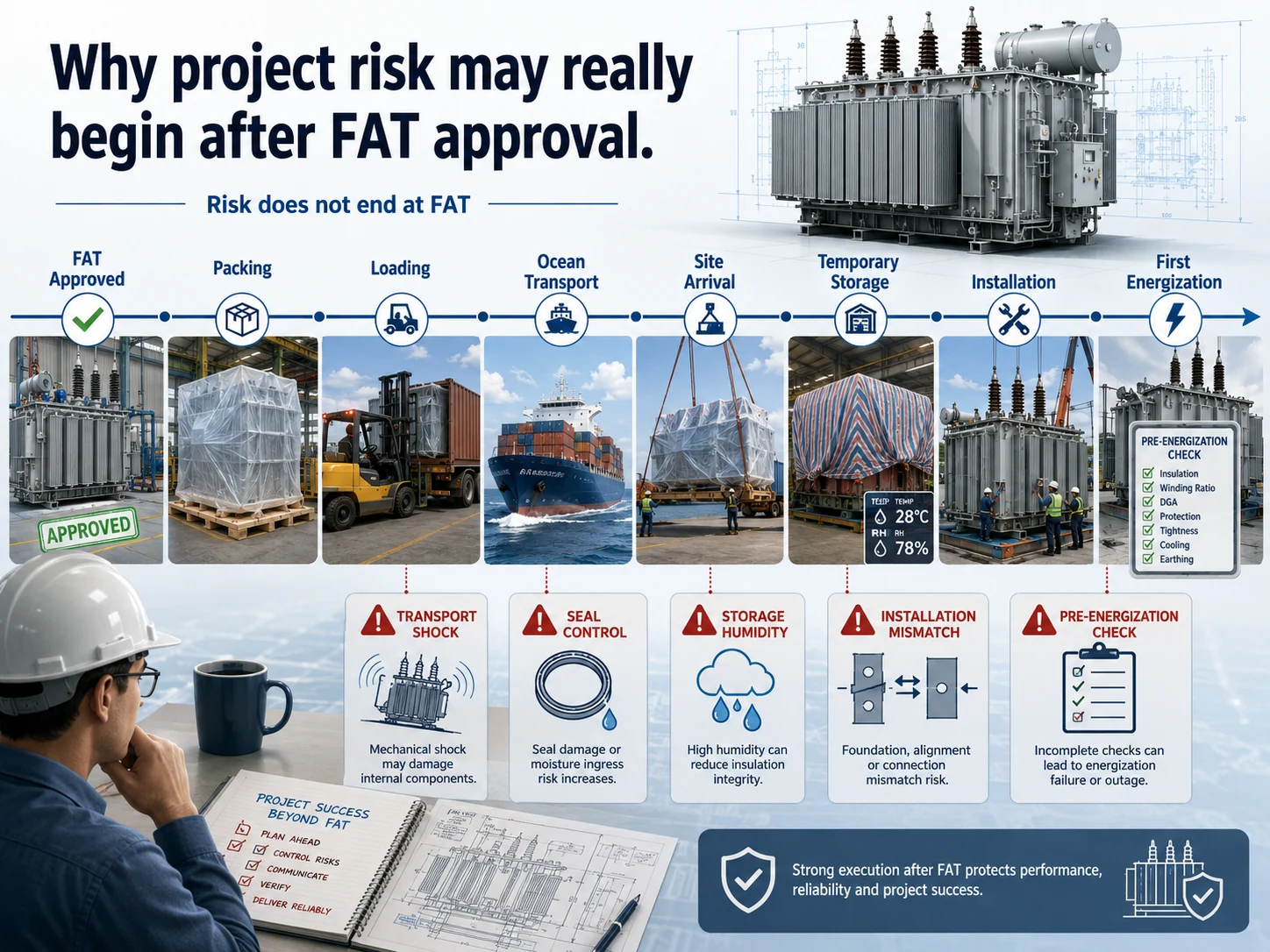
The technical backbone is the complete engineering lifecycle from factory release to first energization. The mistake was not technical incompetence. It was a mental model: treating FAT as the finish line. FAT can demonstrate that an agreed set of inspections and tests were completed under factory conditions. It does not replace loading verification, transport records, site receiving, preservation during storage, installation-interface checks, pre-energization inspection, or observation during first energization. Once the transformer leaves the factory, risk does not disappear; it changes from manufacturing risk into delivery-chain risk.
That is why a serious buyer needs a complete engineering lifecycle, not a loose collection of “installation tips.” The useful question at every stage is: what evidence must be handed to the next stage? At loading: what packages and serial-numbered items actually crossed the container door? During transport: what happened to the unit? At receiving: what condition was observed before acceptance was signed? During storage: who checked sealing, weather protection and preservation? During installation: which approved drawings and interfaces were verified? Before energization: who confirmed protection, cooling, oil level, wiring and mechanical condition? After first energization: what baseline was recorded?
The most powerful procurement action is to turn those questions into project gates before the PO is released. FAT release should not be described as “final delivery.” The packing list should identify packages rather than hiding accessories under “1 lot.” Site acceptance should require a documented receiving inspection. Extended storage should trigger periodic checks. First energization should require a signed pre-energization checklist and a recorded initial operating baseline. None of these controls is glamorous. That is exactly why they work: they remove ambiguity before the schedule is under pressure.
Daniel later changed the first line of his project closeout checklist to: “FAT proves the transformer is ready to leave the factory. Project success must still be proven all the way to stable first power-on.” It was not a marketing slogan. It was a better procurement model.
Technical deep dive
Continue with the paired Wiki: complete engineering lifecycle from factory release to first energization
Project Action
Put the delivery chain into the PO instead of discussing it after the transformer reaches site. Send the project schedule, specification or delivery checklist and TransformerGrid can help structure the responsibility boundaries from FAT through first energization.
Selected for State Grid projects. Proven across extreme climates.
Manufacturing experience backed by documented project awards through a verified manufacturing partner.
Buying or sourcing a transformer? Contact:
WhatsApp: +86 176 8746 9988