Every Nameplate Value Was Correct. The Team Still Refused to Energize
Paired technical guide: pre-energization inspection
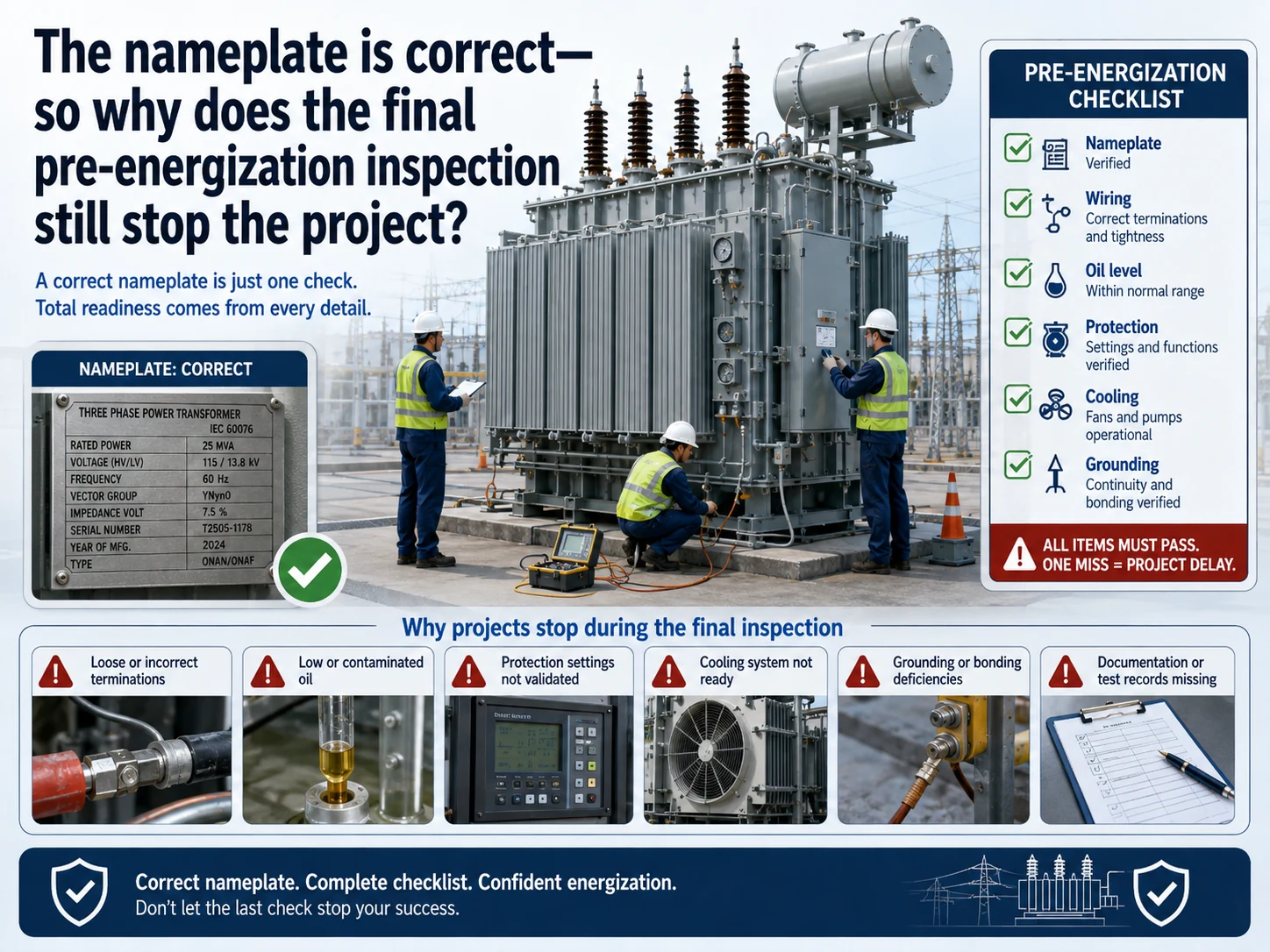
What happened — and why it matters
At 10 p.m., the project had one action left: close the breaker. Nameplate data matched the contract. Ratio, rating, frequency and vector group had been checked. The owner had notified operations. The construction manager wanted the job finished that night. Nina, the commissioning engineer, stopped the energization. She found two open issues: the cooling control had not completed its automatic-start verification, and one protection trip contact at the control-room end was still under a temporary bypass. Neither problem appeared on the transformer nameplate.
The technical backbone is the pre-energization inspection. That is the difference between “the parameters are correct” and “the system is ready.” The nameplate confirms the identity of the equipment. Pre-energization inspection confirms whether this transformer, at this site, with this wiring, protection, cooling and mechanical state, is prepared to accept electrical stress. HV and LV connections, grounding, oil level and sealing, protection circuits, temperature signals, fans or pumps, valve positions, removal of transport restraints, housekeeping and safety isolation are all part of the final mile.
Schedule pressure is strongest at exactly this moment. Months of work are behind the team and everyone wants to “energize now and close the small items later.” Some punch-list items truly may be minor. Others directly affect protection, cooling or operating boundaries. The right approach is not a universal rule that every small item blocks power. It is a controlled classification by the responsible team: which open items are energization blockers, which can be accepted under defined conditions, and who owns closure.
Procurement documents can make that field decision easier. Require terminal drawings, protection and alarm matrices, cooling-control logic and site checklists. Verify key actions as far as practical during FAT, then use the same logic to close the loop at site. When a commissioning engineer says “not ready,” the statement should point to an unverified function, not a feeling.
Nina delayed the project by ninety minutes. The bypass was removed, the automatic cooling logic was verified, the responsible people signed, and only then was the breaker closed. Nobody complained afterward. The expensive decision was not waiting ninety minutes. It would have been energizing ninety minutes earlier without knowing the true system state.
Technical deep dive
Continue with the paired Wiki: pre-energization inspection
Project Action
Turn pre-energization inspection from “site experience” into a project-controlled document covering nameplate, wiring, oil, protection, cooling and mechanical condition.
Selected for State Grid projects. Proven across extreme climates.
Manufacturing experience backed by documented project awards through a verified manufacturing partner.
Buying or sourcing a transformer? Contact:
WhatsApp: +86 176 8746 9988