Two Crates Arrived Empty: The Missing Control Was Not Inspection — It Was Loading Proof
Paired technical guide: transformer loading integrity control
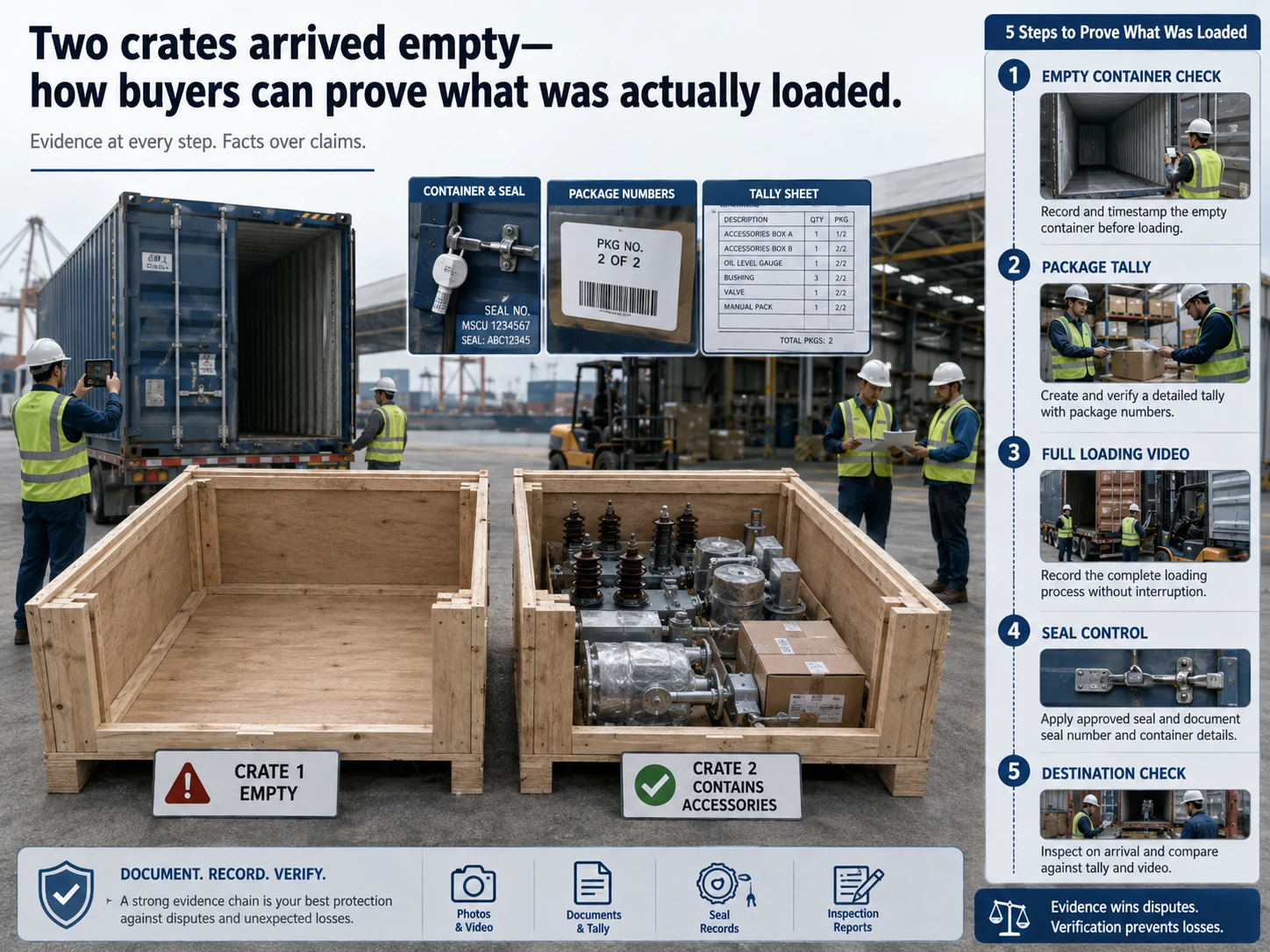
What happened — and why it matters
When the destination warehouse opened the second empty crate, procurement manager Maya started taking photos. When the third crate was checked, she stopped photographing and opened her email archive instead. The supplier had factory inspection photos. The forwarder had pictures of the container after loading. The carrier had a seal number. The bill of lading showed the expected package count. Everyone had “evidence,” yet none of it answered the simplest question: before the container doors were sealed, had those two crates ever contained the goods they were supposed to contain?
The technical backbone is the transformer loading integrity control. This is where many procurement teams confuse inspection with loading supervision. An inspection can confirm that goods existed and met an agreed inspection scope at a certain moment. But if the goods are moved, substituted, split between containers, or loaded after the inspector leaves, “inspection passed” is not the same statement as “the correct cargo was completely loaded into this container.” The missing control is not another certificate. It is continuity.
A defensible chain starts with an empty-container inspection and a package-level packing list. Each package is tallied as it crosses the container door. High-risk or sealed crates may need content witnessing before final closure. Video should cover the sequence from first package to last package, then door closure, locking rods and the application of the seal. Container number and seal number should be captured together. VGM or another verified weight can be compared with expected gross weight as a cross-check. At destination, the process runs in reverse: record the container and seal before opening, record first opening, and re-tally packages against the same list.
The logic matters. An intact seal can help show whether the container was opened after sealing; it cannot prove the cargo was complete before the seal was applied. VGM can reveal a weight inconsistency; it cannot identify which crate is wrong. A final photo of a closed container can show almost nothing about the loading sequence. These tools are strongest when they overlap.
Transformer projects are more exposed than they appear. Nobody is likely to “forget” the main tank without anyone noticing. But one accessory crate can stop an entire site: bushing parts, control devices, gaskets, spare parts, special tools, installation hardware, detached accessories. The cost of the missing package is often small compared with the crane standby, installation crew, outage window and schedule consequences it creates.
For higher-risk shipments, the most valuable inspection dollar may be spent on a buyer-appointed independent witness who starts before loading begins, not after half the container is already full. The goal is not to promise that short shipment can never happen. The goal is to make short-loading, misloading, empty-crate substitution and later blame-shifting much harder to accomplish without leaving a contradiction in the evidence.
Maya did not end the call by asking, “How could this happen?” She asked one question: “Please send me the continuous record from empty-container inspection through final sealing.” The silence that followed was the reason this requirement belongs in the PO.
Technical deep dive
Continue with the paired Wiki: transformer loading integrity control
Project Action
For higher-risk export orders, write third-party loading supervision as an executable witness point rather than a vague sentence. Send the packing list, packing plan and container plan and TransformerGrid can help structure the tally, continuous-video, seal and destination-recheck checklist.
Selected for State Grid projects. Proven across extreme climates.
Manufacturing experience backed by documented project awards through a verified manufacturing partner.
Buying or sourcing a transformer? Contact:
WhatsApp: +86 176 8746 9988