Pad Mounted Transformer Protection and Grounding Guide: How Lucas Reviewed Bayonet Fuse, ELSP Fuse, Surge Arrester and X0 Grounding Before RFQ
1. Lucas's RFQ Started with Protection and Grounding Questions
Lucas Bennett, an experienced electrical contractor and utility coordination manager, was overseeing the power distribution infrastructure for a new light industrial commercial park. His project had already confirmed the essential need for an outdoor pad mounted transformer to step down the grid voltage for the facility. The basic load calculations were complete, and the team knew the required kVA and voltage parameters.
However, when Lucas submitted his preliminary electrical drawings to the local utility company for review, the response was not an immediate approval. Instead, the utility engineers returned a list of pressing questions regarding the specific pad mounted transformer protection and pad mounted transformer grounding configurations. They needed exact details concerning the Bayonet fuse coordination, the presence of an ELSP fuse, surge arrester ratings, basic impulse level (BIL), impedance values, X0 grounding methodology, the internal ground bus, grounding terminals, and the required cable entry direction.
If protection and grounding are not confirmed before RFQ, the transformer may face severe approval, installation, or commissioning problems even when the basic kVA and voltage look completely correct. Lucas realized that skipping these details in the quotation phase could lead to a catastrophic delay, forcing him to modify or entirely replace a heavy, expensive piece of equipment at the eleventh hour.
2. Why Protection Configuration Matters in Pad Mounted Transformer Projects
A pad mounted transformer serves as the critical junction between the high-voltage utility grid and the low-voltage commercial facility. Because it sits at this boundary, the protection configuration is not merely an optional upgrade; it is the fundamental defense mechanism that shields both the utility network from facility-side faults and the facility from utility-side surges.
Protection coordination ensures that in the event of an electrical fault, the correct fuse or breaker trips at the correct time, isolating the problem without shutting down the entire regional grid. This requires careful selection of internal fuses and voltage surge mitigators. A pad mounted transformer is a customized product, not a shelf item that can be imported immediately without technical confirmation. High-quality pad mounted transformers require confirmation of project country, utility requirements, single-line diagram, primary voltage, secondary voltage, kVA, phase, frequency, feed configuration, fusing, surge arrester, BIL, impedance, X0 grounding, cable entry direction, testing documents, and delivery schedule before production can be arranged.
Lucas knew he had to map out the exact protective components required by the approved electrical design before he could trust any quotation from a manufacturer.
3. Bayonet Fuse: What Buyers Should Confirm Before Quotation
One of the most common and essential overcurrent protection devices in an oil-filled transformer is the Bayonet fuse. Designed to protect the equipment from secondary faults and excessive overloads, the Bayonet fuse is immersed in the dielectric fluid and is externally replaceable using a hot stick by qualified personnel.
When Lucas reviewed his project notes, he saw that the utility required a specific melting curve and sizing for the Bayonet fuse to coordinate properly with the upstream feeder breakers. If the Bayonet fuse is sized incorrectly, it may trip prematurely during normal motor starting operations inside the commercial park, or worse, fail to clear a sustained secondary short circuit, leading to severe thermal damage to the transformer windings.
Buyers must confirm the required fuse rating, the type of element (e.g., dual-sensing, fault-sensing, or overload-sensing), and the physical arrangement of the Bayonet fuse holder within the primary compartment. Lucas made sure to document these specific utility requirements before drafting his RFQ.
4. ELSP Current-Limiting Fuse: When Additional Fault Protection May Be Required
While the Bayonet fuse is excellent for handling secondary faults and standard overloads, it has limitations when confronted with massive, high-energy primary faults. This is where the ELSP fuse (a type of backup current-limiting fuse) becomes critical.
The ELSP current-limiting fuse is typically installed in series with the Bayonet fuse. It operates only under severe internal transformer fault conditions. By limiting the peak fault current and rapidly clearing the circuit in less than a half-cycle, the ELSP fuse prevents catastrophic equipment failure, tank rupture, and collateral damage to surrounding infrastructure.
Lucas reviewed the utility fault current data. The regional grid had a high available fault current that exceeded the interrupting rating of standard expulsion fuses. Therefore, confirming the inclusion of an internal ELSP fuse alongside the Bayonet fuse was a non-negotiable item on his quotation checklist.
Safety Warning: Electrical Operation
Final protection and grounding design depends on utility requirements, local code, approved design documents, and qualified engineering review. Electrical operation, fuse replacement, and maintenance must only be performed by trained, qualified personnel using appropriate PPE and insulated hot sticks under approved safety protocols.
5. Surge Arrester and BIL: Protecting Against Voltage Stress
Overcurrent protection handles excessive amperage, but what about excessive voltage? Pad mounted transformers are routinely subjected to voltage spikes caused by lightning strikes on overhead feeder lines or transient switching surges from utility operations. To mitigate this risk, a surge arrester is installed.
A surge arrester acts as a high-speed voltage pressure relief valve. Under normal operating voltage, it acts as an insulator. When a high-voltage surge strikes, the arrester instantly becomes conductive, clamping the voltage spike and shunting the excessive energy directly to ground, thereby protecting the transformer's internal insulation.
Lucas also had to verify the transformer BIL (Basic Impulse Level). The BIL represents the peak transient voltage the transformer's internal insulation can withstand without breaking down. The surge arrester rating and the transformer BIL must be carefully coordinated in a process known as insulation coordination. Lucas confirmed that the utility required a 95 kV BIL for the 15 kV class primary, paired with a properly rated distribution-class surge arrester.
6. X0 Grounding, Neutral Connection and Ground Bus
With overcurrent and overvoltage protection addressed, Lucas turned his attention to grounding. A solid, low-resistance grounding path is vital for personnel safety and for the correct operation of protective relays and fuses.
In a typical Wye-connected secondary (e.g., 480Y/277V), the central neutral point is brought out to a specific terminal designated as the X0 terminal. X0 grounding involves securely connecting this neutral point to the earth ground. This stabilizes the phase-to-neutral voltages and provides a definitive return path for unbalanced phase currents and ground faults.
Furthermore, the transformer must include a robust ground bus and external grounding terminals. Grounding bar and ground pads help ensure that the transformer tank and compartments are properly bonded to earth. This matters for personnel safety, utility inspection, and maintenance access. Lucas ensured his RFQ specified copper-faced or stainless steel grounding pads located in both the primary and secondary compartments.
7. Primary and Secondary Compartments: Where Protection and Grounding Become Visible
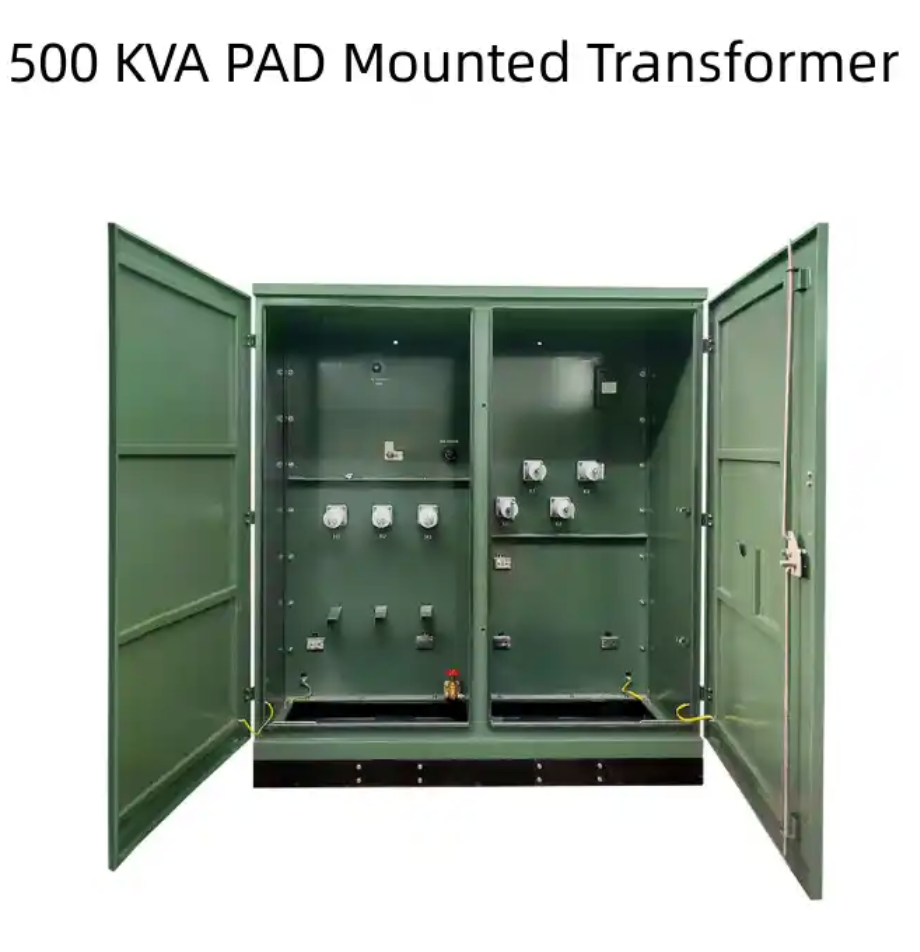
A pad mounted transformer is divided into specific compartments. The primary compartment houses the high-voltage connections, the Bayonet fuse holders, the operational switching handles, and the surge arresters. The secondary compartment houses the low-voltage spade terminals, the X0 bushing, and the low-voltage ground connections.
Lucas knew that the physical arrangement within these compartments dictated the cable entry direction and the required bending radius for the heavy utility cables. If the internal ground bus is positioned incorrectly, or if the surge arresters block access to the load-break switches, the installation contractor will face severe difficulties. A clear understanding of the compartment layout is essential before production begins.
8. Why Lucas Started Communication Before the Next Project Became Urgent
Many buyers wait until the concrete pad is poured and the site is ready before they start searching for a transformer. Lucas knew this was a dangerous approach. Because a pad mounted transformer requires deep engineering review—specifically concerning protection coordination and utility compliance—waiting until the last minute severely limits options and inflates costs.
Lucas encourages electrical managers, contractors, EPC teams, and distribution project owners to build an early communication channel with TransformerGrid before the transformer becomes urgent. Any transformer-related work can be discussed first: drawings, nameplate photos, voltage, grounding, fusing, protection, accessories, delivery schedule, future project planning, or uncertain RFQ details. By addressing the Bayonet fuse and X0 grounding questions weeks in advance, Lucas eliminated the panic of unexpected compliance rejections.
9. What Lucas Sent Before Requesting a Quotation
To ensure a precise and technically accurate quotation, Lucas prepared a comprehensive package. He did not simply send a one-line email asking for "a 1000 kVA transformer price."
He attached the approved single-line diagram from the engineering firm. He provided the utility requirements document detailing the specific available fault current and necessary BIL ratings. He clearly noted the required inclusion of an ELSP fuse to supplement the standard Bayonet fuse array. Finally, he documented the required layout for the ground bus and grounding terminals to match the underground trenching plan. This level of detail allowed the manufacturing engineers to verify the design feasibility immediately.
10. RFQ Checklist for Pad Mounted Transformer Protection and Grounding Review
Based on his experience navigating strict utility compliance reviews, Lucas compiled this mandatory 21-item checklist to organize RFQ requirements for any future pad mounted transformer project:
| No. | RFQ Specification Item |
|---|---|
| 1 | Single-line diagram |
| 2 | Project country |
| 3 | Utility requirements |
| 4 | Expected kVA |
| 5 | Primary voltage |
| 6 | Secondary voltage |
| 7 | Phase |
| 8 | Frequency |
| 9 | Loop feed or radial feed |
| 10 | Fault current data if available |
| 11 | Impedance |
| 12 | BIL |
| 13 | Bayonet fuse |
| 14 | ELSP fuse |
| 15 | Surge arrester |
| 16 | X0 grounding |
| 17 | Ground bus |
| 18 | Grounding terminals |
| 19 | Cable entry direction |
| 20 | Testing documents |
| 21 | Delivery schedule |
11. How TransformerGrid Helps Review Transformer-Side Protection Requirements
TransformerGrid works as a technical communication partner before quotation. When buyers submit their single-line diagrams or utility specification sheets, our engineering team thoroughly reviews the protection and grounding requirements. We verify that the requested Bayonet fuse and ELSP current-limiting fuse coordinate properly with the specified primary voltage and fault current data.
Early technical communication and quotation review are free of charge. No consulting fee. No hidden fee. No pressure to order. The purpose is to help buyers win communication time, production review time, manufacturing time, and delivery planning time for the next project. By identifying missing surge arrester details or unverified grounding terminal locations early, we prevent costly rework on site.
12. Conclusion
Pad mounted transformer protection and grounding are highly technical components that dictate the safety, compliance, and functionality of an entire power distribution project. As Lucas demonstrated, understanding the roles of the Bayonet fuse, ELSP fuse, surge arrester, and robust X0 grounding prevents severe setbacks during utility inspection and site commissioning.
By engaging in an engineering review before quotation, electrical contractors and project managers can secure a transformer that fits perfectly within the local grid architecture, ensuring reliable power delivery without unexpected installation delays.
13. FAQ
Planning a Pad Mounted Transformer Project?
Send your drawings, single-line diagram, nameplate photos, voltage, kVA, utility requirements, protection requirements, grounding details and delivery schedule. If you do not have complete drawings yet, you can still contact TransformerGrid early. Our engineers can help review transformer-side requirements before quotation.
Email: sales@transformergrid.com | WhatsApp: +86 17687469988